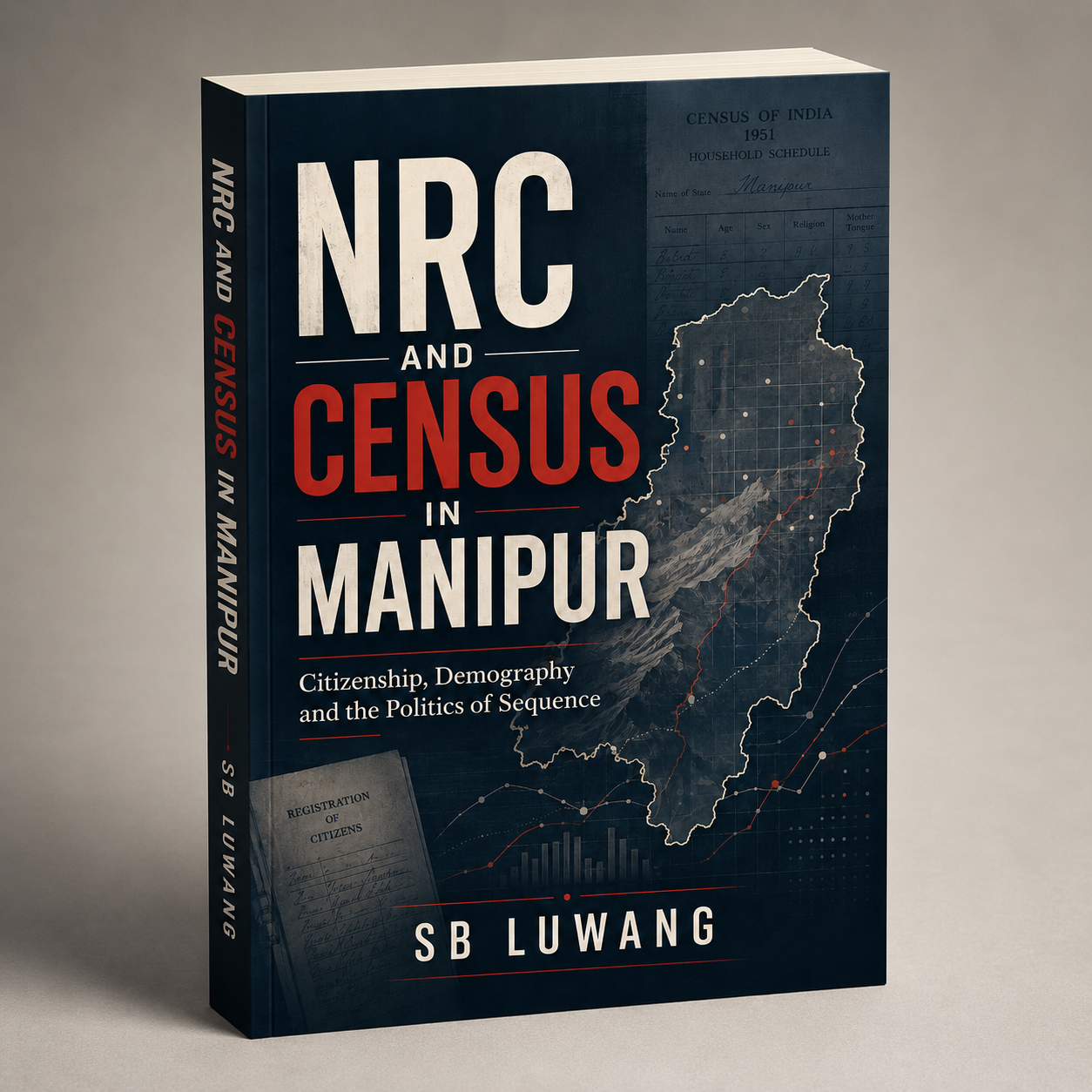
Should Manipur complete a National Register of Citizens before Census figures are used for major political decisions?
What is the difference between a Census, NRC/NRIC, NPR, Aadhaar, electoral roll and the Inner Line Permit system?
Can Assam’s NRC model—and its 24 March 1971 cutoff—simply be copied in Manipur?
And why does Census 2027, the first Census after 2026, make the debate over citizenship, population and future delimitation especially significant?
NRC and Census in Manipur provides an extensive legal, historical and public-policy examination of these questions.
Drawing on the Constitution of India, the Citizenship Act, Census law, official government records, Manipur Legislative Assembly resolutions, Supreme Court judgments, historical Census data and the experience of Assam’s NRC, SB Luwang separates political slogans from the underlying law and evidence.
Inside the Book
Readers will explore:
- The history and legal foundations of Indian citizenship
- Section 14A and the National Register of Indian Citizens
- How an NRC is actually prepared and verified
- Census vs NRC vs NPR vs Aadhaar vs voter lists
- The Assam Accord and Section 6A of the Citizenship Act
- The significance of the 24 March 1971 Assam cutoff
- What Assam’s NRC experience teaches Manipur
- Manipur’s population growth from 1901 to 2011
- Migration, demographic change and the danger of interpreting population growth as automatic proof of illegal immigration
- The India–Myanmar border and post-2021 displacement
- Refugees, foreigners, migrants and citizens as separate legal categories
- Inner Line Permit and its relationship to citizenship
- Manipur’s 2022 and 2024 NRC resolutions
- Census 2027 and India’s new digital enumeration system
- Census confidentiality and public trust
- Population versus citizen population
- Census 2027 and future delimitation
- Electoral integrity and citizenship
- Documentary citizenship and the risk of wrongful exclusion
- Problems faced by women, rural families, displaced persons and citizens with weak documentation
- Why ethnicity cannot legally determine citizenship
- Claims, hearings, appeals and judicial safeguards
- What happens after exclusion from an NRC
- A proposed Manipur Legacy Records Mission
- A practical accepted-documents framework
- Independent NRC oversight and data protection
- Border management beyond NRC
- Three possible NRC–Census sequencing models
The Central Argument
This book makes an important distinction:
The Census should count the population accurately. NRC should determine citizenship lawfully.
Being counted in the Census does not make a person an Indian citizen.
Likewise, a non-citizen who is actually living in a territory cannot simply be made invisible for demographic and infrastructure planning.
The deeper question is therefore not merely whether NRC should occur before Census enumeration.
It is whether Manipur should enter a new era of delimitation, representation and demographic policymaking without a credible distinction between its resident population and its citizen population.
A Balanced Approach
This is not a book that classifies communities as citizens or foreigners based on ethnicity, religion, tribe, language or surname.
Instead, it argues that citizenship must be determined individually, through Indian law, documentary evidence and due process.
The book examines both:
The case for NRC
—citizenship clarity, border-state security, electoral integrity, migration management and demographic confidence.
The risks of a poorly designed NRC
—wrongful exclusion, documentation problems, discrimination, statelessness, administrative overload and social conflict.
The result is a detailed proposal for a lawful and transparent Manipur Citizen-Baseline Framework.
Recommended For
An essential reference for:
- Readers interested in Manipur and Northeast India
- Students of Indian politics and public administration
- Researchers of citizenship and migration
- Civil-services aspirants
- Policymakers and administrators
- Lawyers and law students
- Journalists
- Political-science students
- Historians
- Readers interested in Census 2027 and delimitation
- Anyone seeking to understand the NRC debate beyond slogans

Reviews
There are no reviews yet.