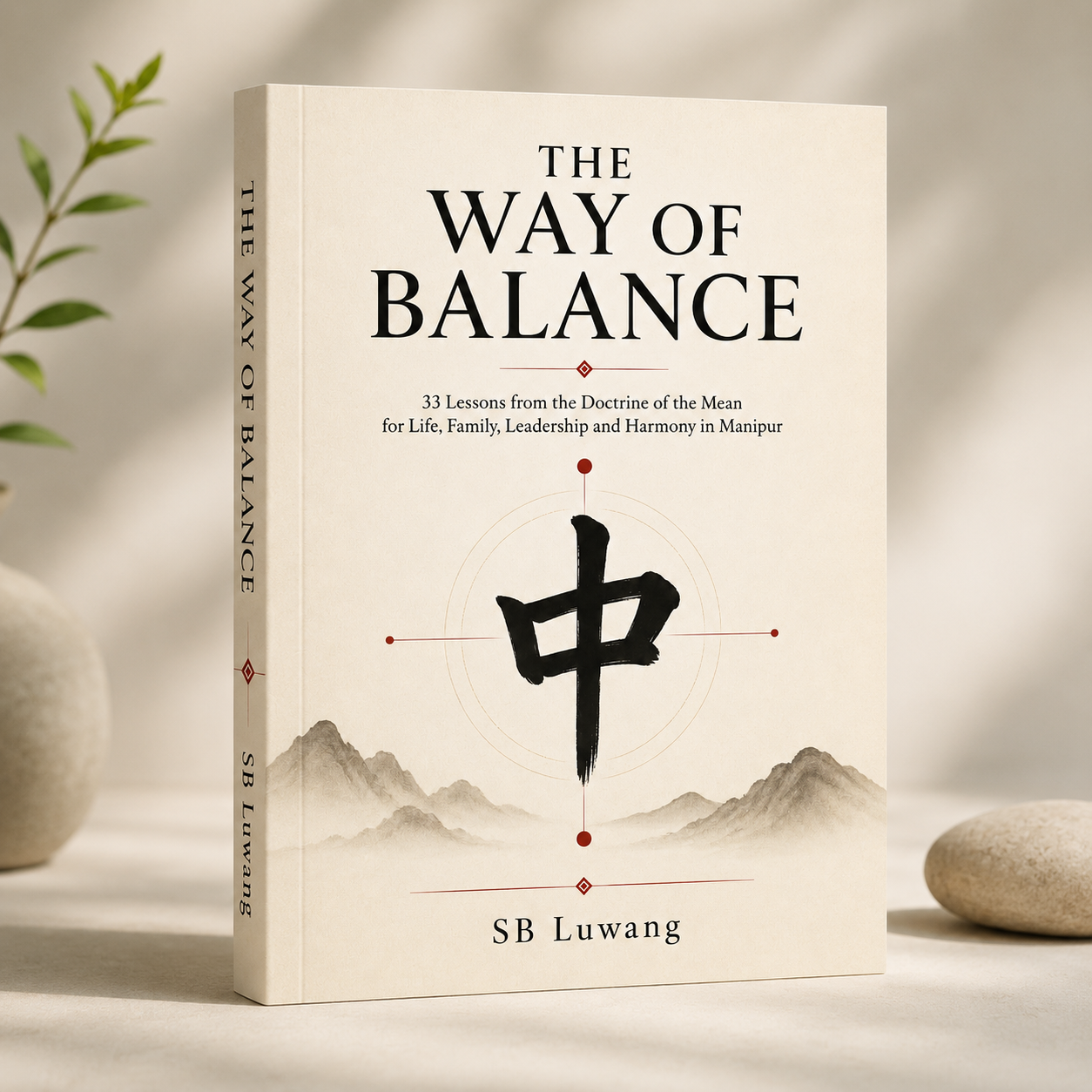
The ancient art of finding the right measure in life
What does it really mean to live a balanced life?
Does balance mean avoiding strong opinions? Staying neutral? Compromising halfway between two sides?
The Way of Balance shows that the classical Confucian idea of Zhongyong—commonly translated as the Doctrine of the Mean—offers something much deeper.
The Mean is not mediocrity.
It is not indecision.
It is not simply standing halfway between two extremes.
It is the discipline of understanding what a particular situation truly requires and responding with the appropriate degree of courage, restraint, compassion, discipline, justice and wisdom.
Drawing inspiration from one of the foundational works of Confucian philosophy, SB Luwang transforms ancient ideas into 33 accessible lessons for contemporary life, with special attention to the realities of families, education, workplaces, leadership and community life in Manipur.
Inside the Book
Explore practical lessons on:
- Understanding what true balance really means
- Recognising the dangers of both excess and deficiency
- Managing anger, fear, ambition and desire
- Developing sincerity and integrity
- Building character when nobody is watching
- Correcting yourself before correcting others
- Developing discipline without becoming harsh
- Pursuing ambition without falling into greed
- Parenting without tyranny
- Raising responsible children
- Building stronger marriages and family relationships
- Understanding the moral responsibility of teachers
- Looking beyond examinations and certificates in education
- Listening before reacting
- Disagreeing without hatred
- Responding responsibly to rumours and social media
- Balancing honour with humility
- Placing justice above blind loyalty
- Understanding why harmony does not require sameness
- Building unity while preserving difference
- Developing balanced and trustworthy leadership
- Connecting personal character with social peace
Harmony Without Uniformity
One of the central ideas of the book is simple but powerful:
People do not have to become identical in order to live together peacefully.
A harmonious society can contain different communities, languages, traditions, opinions and identities.
The challenge is not to eliminate difference.
The challenge is to learn how to remain different without becoming enemies.
This principle gives the ancient philosophy of Zhongyong particular relevance to contemporary Manipur.
From Self-Cultivation to Society
The book follows a progressive journey:
Self → Character → Family → Education → Community → Leadership → Society
Its five major parts are:
Part I — Finding the Centre
Learn what balance actually means and how to respond appropriately to changing circumstances.
Part II — Governing Yourself
Explore integrity, sincerity, habits, discipline, ambition and self-examination.
Part III — Family and Education
Apply balanced thinking to parenting, marriage, kinship, teaching and learning.
Part IV — Living With Others
Learn how to listen, disagree, communicate and build harmony across differences.
Part V — Leadership and Society
Examine justice, responsibility, governance, leadership and the relationship between personal character and social order.
The book concludes with 33 Principles at a Glance, a 30-Day Balance Practice, a glossary of important Chinese philosophical terms, notes and suggested further reading.
Who Should Read This Book?
The Way of Balance is especially suitable for:
- Students and young adults
- Parents and families
- Teachers and educators
- Managers and businesspeople
- Government and institutional leaders
- Community leaders
- Readers interested in Confucius and Chinese philosophy
- Readers of Eastern philosophy and practical wisdom
- Anyone seeking greater emotional balance and self-discipline
- Anyone interested in peace, social harmony and responsible leadership
A Philosophy for Ordinary Life
You do not need to be a scholar of Chinese philosophy to understand this book.
Complex ideas such as Zhong (balance), He (harmony), Cheng (sincerity), Dao (the Way) and Junzi (the exemplary person) are explained in clear, practical language and connected to everyday situations.
Every chapter concludes with:
Reflection Questions • Practical Exercise • One-Sentence Principle
making the book suitable not only for reading but also for personal development, classroom discussion, leadership training and group study.
The central message:
Balance is not standing halfway between two mistakes. It is finding the right place to stand.
And perhaps its most important social lesson:
Peace does not require people to become identical. It requires people to learn how to remain different without becoming enemies.
The Way of Balance is an invitation to begin where lasting harmony has always begun:
within ourselves.


Reviews
There are no reviews yet.