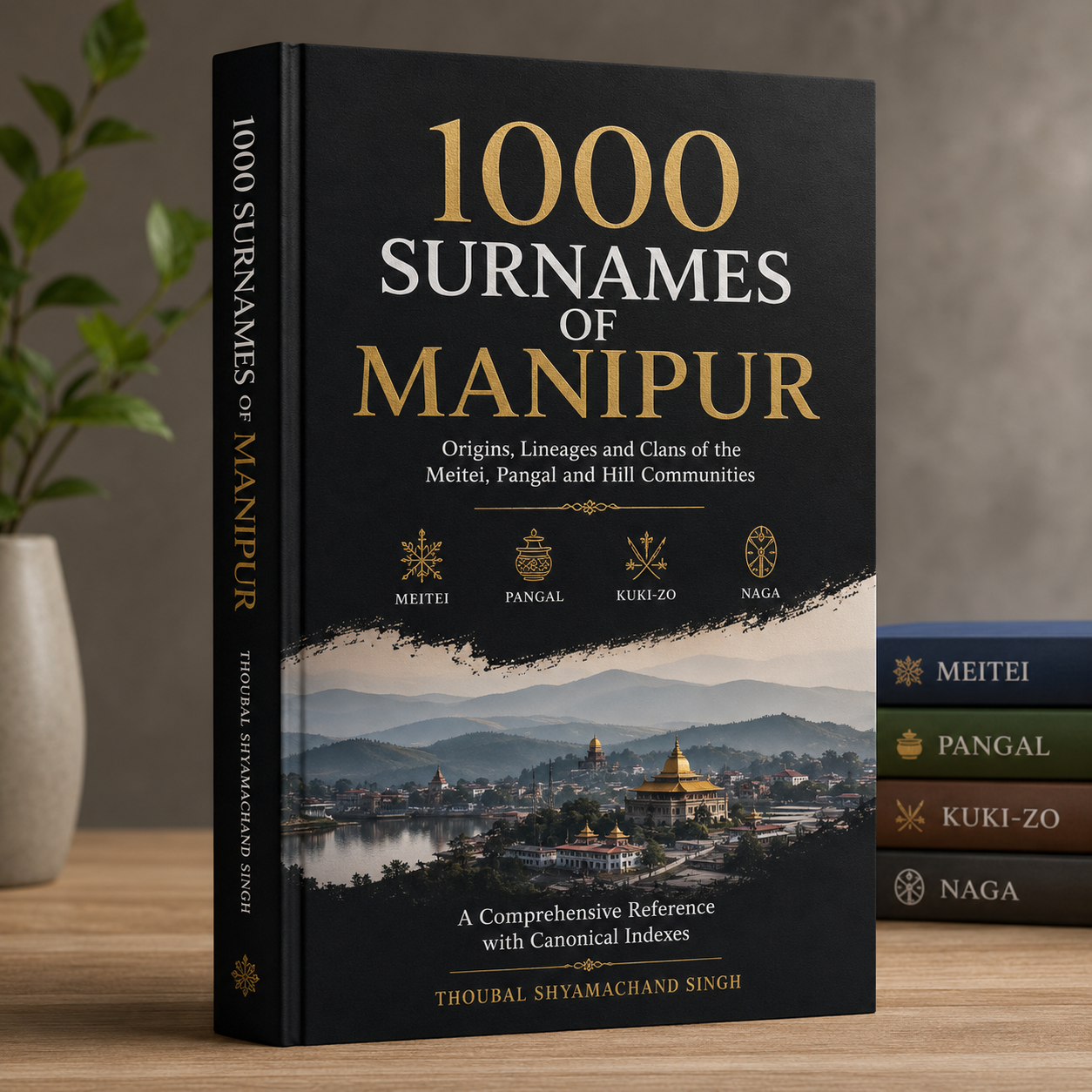
1000 Surnames of Manipur
Families, Clans and Lineages of the Meitei, Pangal, Kuki-Zo and Naga Peoples
Every family name carries a story.
Behind a surname may lie the memory of an ancestor, a village, a migration, a royal office, an occupation, a clan, a lineage or generations of family tradition.
1000 Surnames of Manipur is an extensive cultural and genealogical reference book exploring the remarkable diversity of naming traditions found across Manipur.
Rather than treating every name as a Western-style surname, the book carefully distinguishes between the different kinship institutions used by the peoples of the region—including yumnak, sagei, Yek-Salai, clan, sub-clan, lineage, patriclan, family name and historical clan name.
More Than a List of Names
The book brings together more than 1,000 documented genealogical records, including names associated with:
Meitei
Explore Meitei yumnaks and their relationship with the Seven Yek-Salai—Mangang/Ningthouja, Luwang, Khuman, Angom, Moirang, Kha-Nganba and Sarang-Leishangthem/Chenglei.
Meitei Pangal
Discover historical and contemporary Pangal yumnaks and sageis, including variant spellings, aliases and expanded Mayum forms preserved in historical sources.
Kuki and Kuki-Zo Peoples
Examine clan and sub-clan traditions associated with communities including Thadou, Hmar, Paite, Gangte and related groups.
Naga Peoples of Manipur
Documented clan and lineage traditions include Tangkhul, Rongmei, Liangmai, Mao, Poumai, Maram, Thangal, Maring, Anal, Moyon, Monsang, Lamkang, Chothe, Chiru, Inpui, Kharam, Tarao and others.
Carefully Audited Genealogical Records
Names were reviewed to distinguish between:
- canonical family or clan names;
- branch and sub-clan names;
- historical and extinct clan names;
- spelling variants;
- aliases;
- duplicate documentary forms;
- village-specific lineages;
- names shared independently by different communities.
A shared spelling is not automatically treated as proof of shared ancestry.
For example, identical or similar names appearing in different communities are retained as separate community-qualified genealogical records unless reliable evidence demonstrates a relationship.
Comprehensive A–Z Reference
The heart of the book is an alphabetical reference dictionary designed for quick consultation.
Readers can search for a family or clan name and identify its:
- community;
- genealogical level;
- variant spellings;
- historical forms;
- parent clan or lineage;
- locality where relevant;
- canonical status;
- related names and cross-references.
Additional Reference Sections
The book also contains:
- Community-Qualified Index
- Parent Clan–Branch Index
- Variant Spelling Index
- Historical and Extinct Name Index
- Locality-Qualified Clan Records
- Meitei Salai–Yumnak Cross-References
- Canonical Redirect Tables
- Glossary of Kinship Terminology
- Research Notes and Bibliography
Who Is This Book For?
1000 Surnames of Manipur is suitable for:
- families researching their ancestry;
- students of Manipur history and society;
- genealogists;
- anthropologists;
- historians;
- teachers and educational institutions;
- libraries;
- community organisations;
- diaspora communities;
- young people wishing to understand their family heritage.
A Reference for Future Generations
Names change spelling. Families migrate. Villages grow. Oral histories fade.
Recording these traditions today helps preserve a valuable part of Manipur’s social memory for future generations.
1000 Surnames of Manipur is therefore not simply a surname directory—it is a reference guide to the interconnected histories of families, clans, communities and lineages across Manipur.


Reviews
There are no reviews yet.