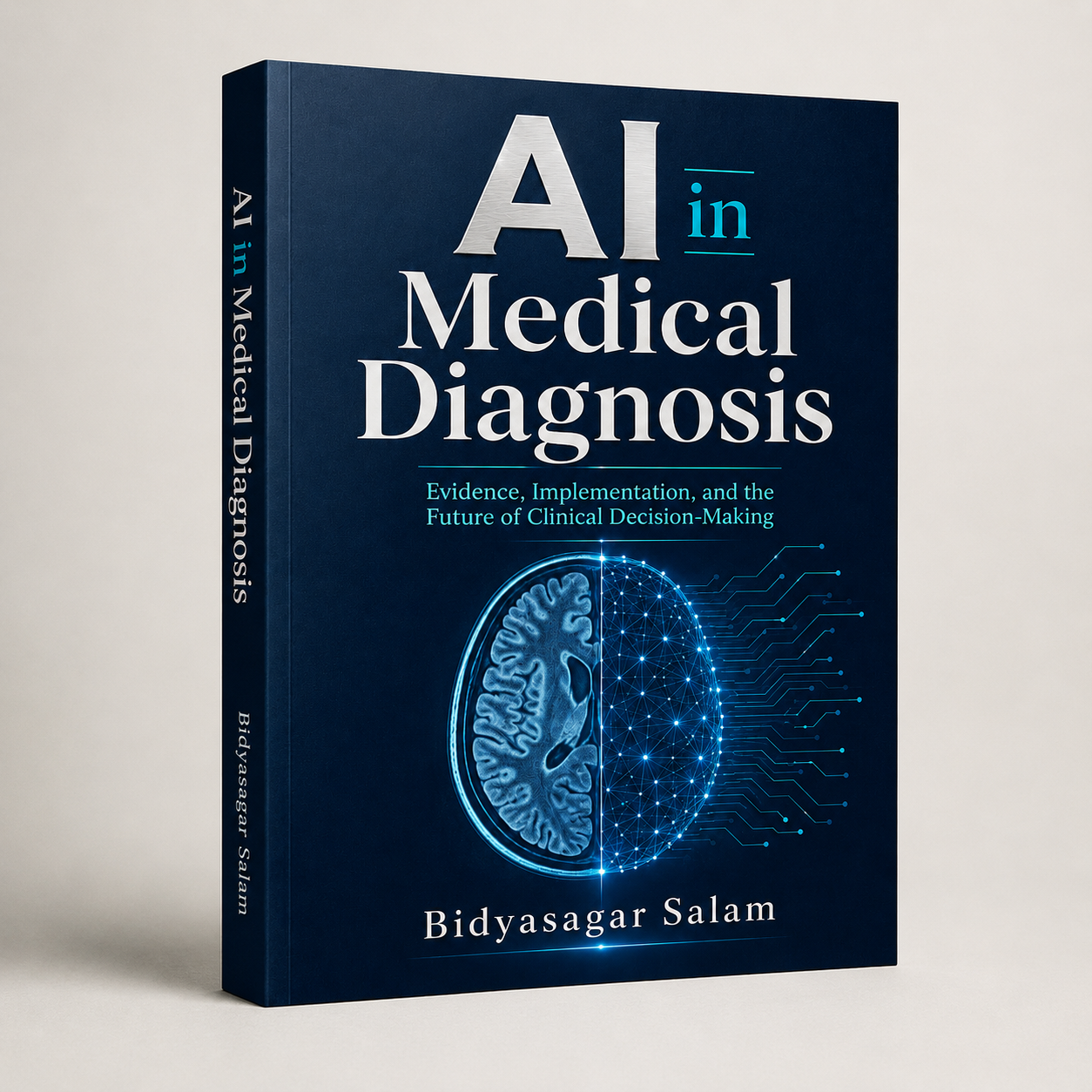
AI is changing medical diagnosis—but when should we actually trust it?
Artificial intelligence can now detect disease in medical images, analyze ECG signals, screen for diabetic retinopathy, assist pathologists, identify high-risk patients, interpret complex clinical data, and generate diagnostic suggestions through large language models.
But impressive AI performance does not automatically mean better medicine.
AI in Medical Diagnosis: Evidence, Implementation, and the Future of Clinical Decision-Making provides a comprehensive and accessible examination of how diagnostic AI works, where it is already useful, where it can fail, and how healthcare organizations can implement it safely.
Rather than presenting AI as a replacement for doctors, this book examines the more realistic and important future of human + machine diagnosis.
Inside the Book
Readers will learn about:
- The foundations of artificial intelligence, machine learning, deep learning, and generative AI
- How AI systems learn from medical data
- Sensitivity, specificity, PPV, NPV, AUROC, calibration, and other diagnostic metrics
- Internal, external, prospective, and real-world validation
- The AI Diagnostic Evidence Ladder
- Dataset shift, model drift, data leakage, and shortcut learning
- Human–AI collaboration and automation bias
- AI applications in radiology and medical imaging
- AI-supported breast cancer screening
- Autonomous diabetic-retinopathy diagnosis
- Digital pathology and prostate-cancer detection
- Dermatology and computer vision
- AI-enhanced ECGs and cardiac diagnosis
- Neurology, stroke, and emergency imaging
- Gastrointestinal endoscopy and polyp detection
- Laboratory medicine and infectious-disease AI
- Genomics and precision diagnosis
- Large language models as diagnostic assistants
- Hallucinations and generative-AI failure
- Multimodal medical AI
- AI agents and automated diagnostic workflows
- Algorithmic bias and healthcare equity
- Explainable AI and clinical transparency
- Privacy, cybersecurity, and medical-data governance
- Responsibility and liability when AI makes mistakes
- FDA, WHO, EU, ICMR, and CDSCO regulatory frameworks
- How hospitals should evaluate and purchase diagnostic AI systems
- AI implementation in low-resource healthcare
- Opportunities for diagnostic AI in India
- Economics and cost-effectiveness of medical AI
- How to build an AI-ready hospital
- The future of diagnosis and AI-assisted medicine
A Framework for Separating Evidence from Hype
A central feature of the book is the AI Diagnostic Evidence Ladder, a nine-level framework for evaluating whether an AI system has progressed from technical performance to genuine clinical value:
- Technical performance
- Internal validation
- External validation
- Prospective clinical evaluation
- Clinician–AI interaction
- Randomized clinical evaluation
- Patient outcomes
- Health-system impact
- Post-market durability
This framework helps readers distinguish a promising research model from an AI system that has actually demonstrated meaningful benefit in clinical practice.
Evidence-Based and Clinically Focused
The book discusses landmark and contemporary evidence including:
- AI-supported mammography screening
- Autonomous diabetic-retinopathy systems
- AI-assisted prostate pathology
- AI-enabled ECG screening
- Generative-AI diagnostic studies
- Randomized studies of physician–AI collaboration
It also examines current approaches to medical-AI governance from the FDA, WHO, CDSCO, ICMR, and European regulatory system.
Who Should Read This Book?
This book is particularly useful for:
- Doctors and clinicians
- Medical students and residents
- Radiologists and pathologists
- Nurses and diagnostic professionals
- Hospital administrators
- Healthcare managers
- Biomedical engineers
- AI and health-tech developers
- Researchers
- Public-health professionals
- Policymakers
- Anyone interested in the future of medicine and artificial intelligence
No programming knowledge is required.
The Central Question
The future of medical diagnosis is unlikely to be doctor versus machine.
The more important question is whether healthcare systems can combine human judgment, clinical context, and machine intelligence in ways that improve accuracy, access, efficiency, safety, and patient outcomes.
AI in Medical Diagnosis provides the concepts and evidence needed to understand that transformation.




Reviews
There are no reviews yet.