What should you do when the plan no longer matches reality?
The hardest decisions rarely arrive when you have perfect information, unlimited time, and abundant resources.
They arrive when something changes.
A customer moves the deadline.
A supplier fails.
A machine stops.
A project begins slipping.
A competitor changes its offer.
A key employee is unavailable.
An opportunity appears unexpectedly.
And suddenly, the original plan is no longer enough.
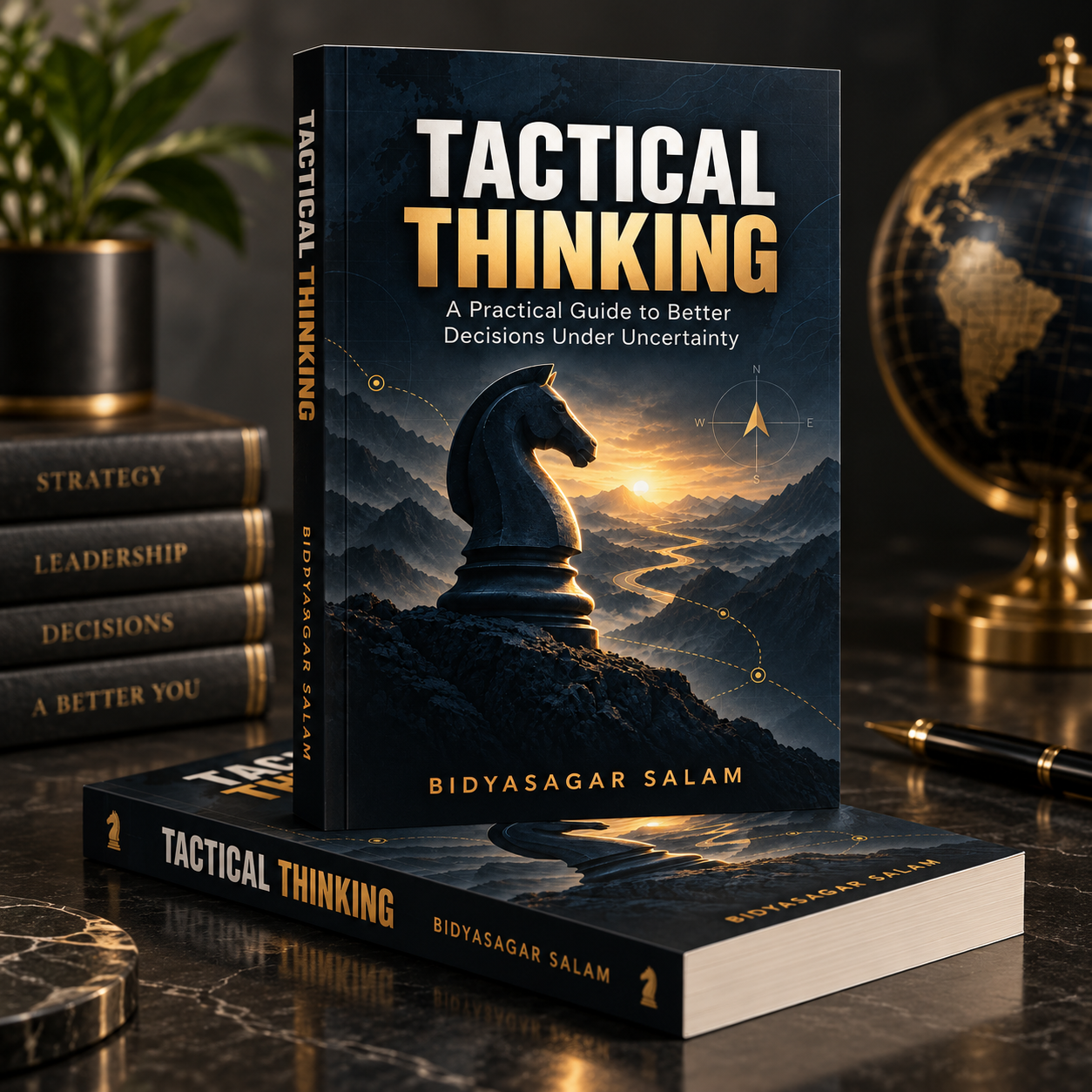
Tactical Thinking is a practical guide to making better decisions in exactly these situations.
Written by Bidyasagar Salam, this book explores how to read changing conditions, identify what matters immediately, choose workable actions, anticipate consequences, execute with clarity, and adapt as new information appears.
At the center of the book is the original TACTIC Loop:
T — Target
Define the immediate outcome that matters.
A — Assess
Understand what has changed, what is known, what is assumed, and what constraints exist.
C — Create
Generate practical courses of action instead of getting trapped in one obvious response.
T — Test
Think one move further. Examine assumptions, risks, reactions, and failure points.
I — Implement
Turn the decision into clear action with ownership, deadlines, boundaries, and checkpoints.
C — Correct
Compare expectation with reality and adjust before the situation gets worse.
Rather than presenting tactical thinking as aggression or military maneuvering, the book applies it primarily to civilian decision-making — business, leadership, entrepreneurship, operations, customer service, negotiation, project management, crisis response, teamwork, and personal decisions.
Inside the Book
You will learn how to:
- distinguish strategy from tactical action;
- identify the real problem behind the visible problem;
- develop stronger situational awareness;
- separate facts, assumptions, signals, and noise;
- recognize bottlenecks and leverage points;
- decide under incomplete information;
- use heuristics without becoming trapped by them;
- manage cognitive bias and overconfidence;
- think in terms of reversibility and optionality;
- preserve resources and flexibility under uncertainty;
- anticipate second- and third-order consequences;
- use tactical premortems before important decisions;
- build if-then triggers and contingency branches;
- communicate clearly under pressure;
- delegate decisions without losing control;
- manage competing priorities and scarce resources;
- recover intelligently when plans fail;
- learn from near misses as well as failures;
- convert experience into reusable tactical judgment.
Practical, Not Just Theoretical
The book includes extensive applied material such as:
- 30 tactical decision games
- realistic business and operational scenarios
- Tactical Situation Sheet
- Decision Journal
- Tactical Premortem Worksheet
- Trigger Matrix
- After-Action Review Template
- 25 Tactical Heuristics
- Tactical Priority Matrix
- decision and escalation frameworks
- a complete 30-Day Tactical Thinking Program
Readers are repeatedly placed inside situations where there may be several reasonable choices rather than one obvious answer.
The objective is not to memorize rules.
It is to improve judgment.
Who Is This Book For?
Tactical Thinking is especially useful for:
- business owners;
- entrepreneurs;
- managers;
- team leaders;
- supervisors;
- project managers;
- professionals;
- students;
- decision-makers;
- anyone responsible for solving problems under pressure.
Whether you are managing a company, handling customers, coordinating projects, making investments of time and resources, or simply trying to make clearer everyday decisions, the principles in this book are designed to help you answer one fundamental question:
What is the next useful move?
The Core Philosophy
Tactical thinking is not about reacting faster than everyone else.
It is about knowing:
- when to move;
- when to wait;
- what to protect;
- what to test;
- what to abandon;
- what information matters;
- what decision can be reversed;
- and what action leaves you in the strongest position for the next decision.
Because the best tactic does more than solve today’s problem.
It improves tomorrow’s position.




Reviews
There are no reviews yet.