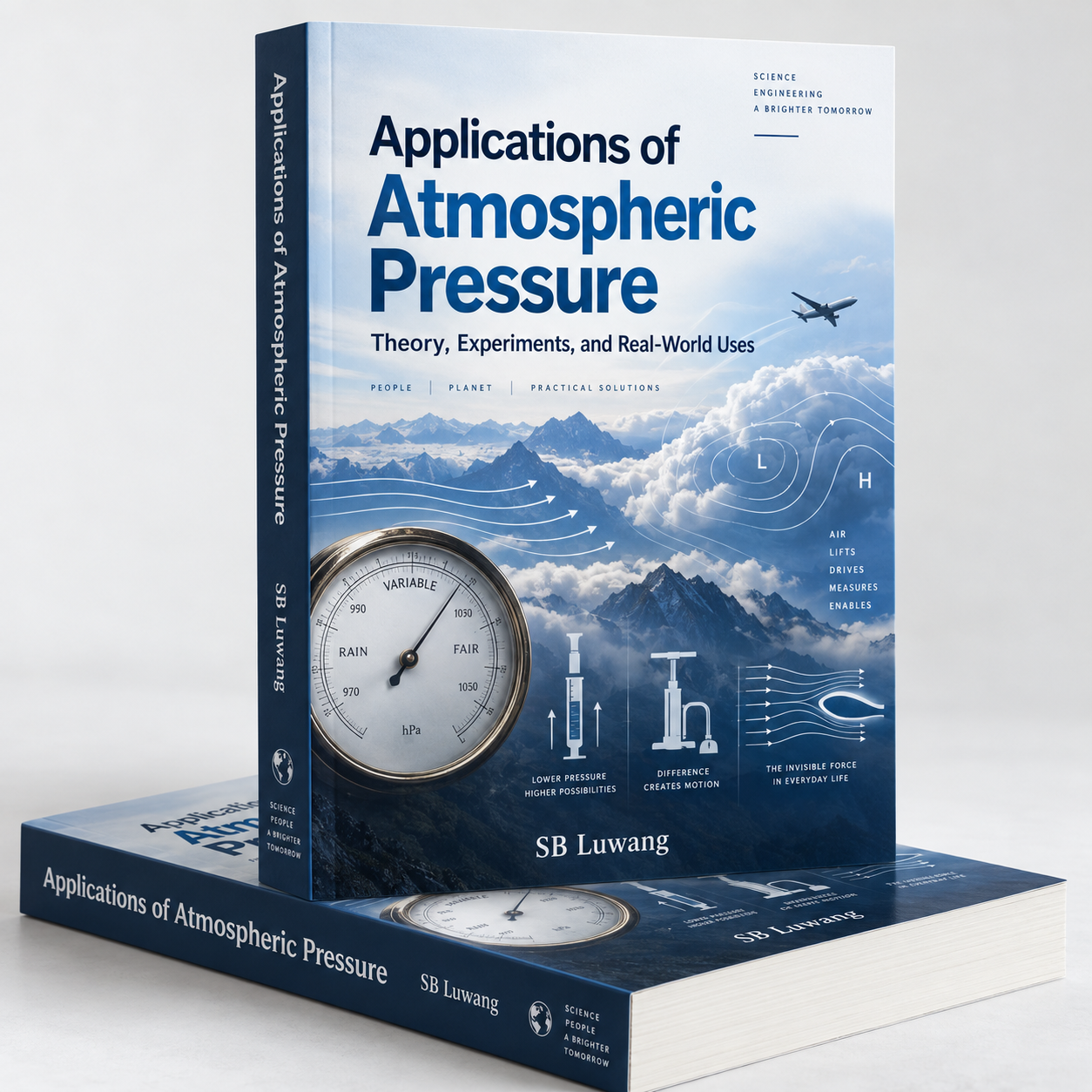
Atmospheric pressure surrounds us every moment, yet many of its most important effects remain invisible.
Why does water rise through a straw? Why does a suction cup stick to glass? Why can a surface pump lift water only to a limited height? Why does water boil at a lower temperature in the mountains? How do aircraft altimeters, vacuum packaging machines, pressure cookers, HVAC systems, pneumatic equipment, and weather systems depend on pressure?
Applications of Atmospheric Pressure by SB Luwang explains these questions through practical science, engineering principles, experiments, calculations, and real-world applications.
Instead of treating atmospheric pressure as a short textbook topic, this book shows how the theory is used across everyday life, industry, aviation, meteorology, fluid systems, vacuum technology, buildings, automotive systems, and human physiology.
What You Will Learn
- Atmospheric pressure and the weight of air
- Pressure, force, and area
- Absolute, gauge, and differential pressure
- Pressure differences and resulting forces
- Barometers and atmospheric-pressure measurement
- Straws, syringes, droppers, and suction cups
- Hand pumps and centrifugal pumps
- Suction height and pump limitations
- Cavitation and pump inlet pressure
- Siphons and fluid systems
- Wind and pressure-gradient forces
- High- and low-pressure weather systems
- Cyclones, storms, and monsoons
- Atmospheric pressure at different altitudes
- Barometric altimeters
- Aircraft pitot-static systems
- Aircraft cabin pressurisation
- Breathing and pressure differences
- Ear-pressure equalisation
- Vacuum theory
- Vacuum pumps
- Vacuum packaging
- Vacuum forming
- Vacuum lifting and material handling
- Pneumatic systems
- Industrial pressure measurement
- HVAC pressure control
- Chimneys and natural draft
- Wind pressure on buildings
- Engine intake pressure
- Vacuum-assisted brakes
- Tyre pressure
- Pressure cookers
- Vacuum drying
- Freeze drying
Practical Experiments Included
Readers can explore atmospheric-pressure principles through experiments such as:
- Inverted water-glass experiment
- Blocked-syringe experiment
- Medicine-dropper demonstration
- Drinking-straw pressure test
- Homemade barometer
- Suction-cup tests
- Balloon-in-a-bottle experiment
- Vacuum-storage demonstration
- U-tube manometer
- Simple siphon experiment
- Pressure-versus-height observation
- Smartphone barometric-altitude measurement
Important Equations Explained
The book introduces and applies essential relationships such as:
Pressure
P = F/A
Pressure Force
F = ΔP × A
Hydrostatic Pressure
P = ρgh
Absolute Pressure
Pabs = Pgauge + Patm
Dynamic Pressure
q = ½ρv²
Boyle’s Law
P₁V₁ = P₂V₂
The equations are explained using practical examples so readers understand not only how to calculate an answer, but also what the result means physically.
Real-World Case Studies
The book examines practical situations including:
- Why a surface pump cannot lift water from an excessively deep well
- Why aircraft cabins must be pressurised
- Why vacuum-packed bags cling tightly to products
- Why atmospheric pressure can fall before a storm
- How vacuum cups lift large glass panels
- Why water boils at lower temperatures in mountain regions
- How vacuum forming shapes plastic products
- How smartphones estimate changes in elevation
- Why large tanks can collapse when venting fails
Historical Experiments
Readers are also introduced to landmark developments in pressure science, including:
- Torricelli’s mercury barometer
- Pascal’s mountain experiment
- Otto von Guericke’s Magdeburg hemispheres
These experiments helped establish the modern scientific understanding of atmospheric pressure and vacuum.
Ideal For
- School and college students
- Physics learners
- Competitive-examination candidates
- Science teachers
- Engineering students and beginners
- Technicians
- Maintenance personnel
- HVAC learners
- Pump operators
- Pneumatic-system learners
- Makers and science enthusiasts
- General readers interested in practical physics



Reviews
There are no reviews yet.