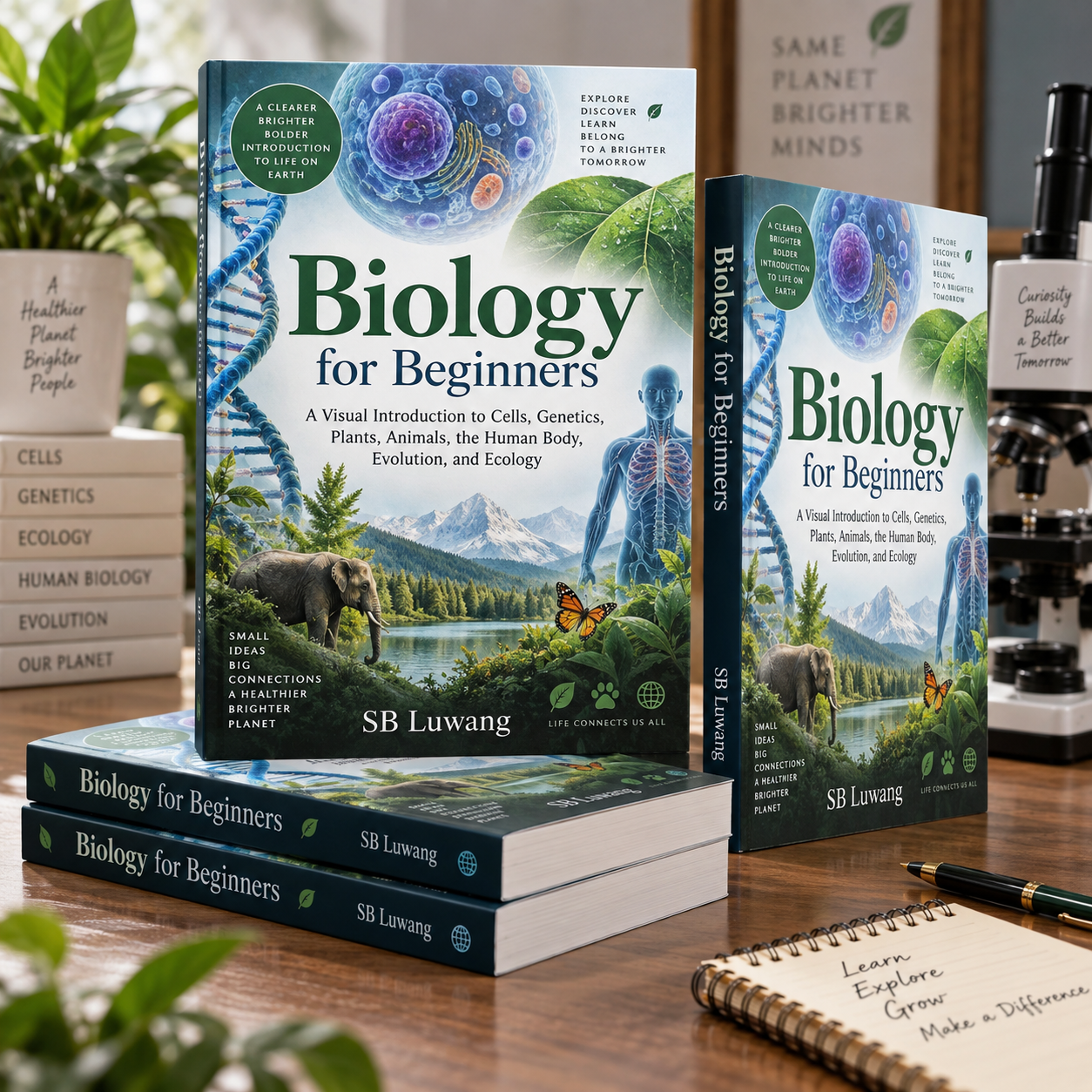
Explore Life from the Smallest Cell to the Largest Ecosystem
Why do living things need energy?
How does DNA carry biological information?
How does the human body maintain balance?
Why do species evolve?
How are organisms connected within ecosystems?
Biology for Beginners provides an accessible introduction to these questions and many more.
Written by SB Luwang, this visual learning guide takes readers step by step through the foundations of modern biology without assuming previous scientific knowledge.
Complex ideas are broken down into manageable explanations supported by diagrams, concept maps, comparison tables, activities, vocabulary, and review questions.
What You’ll Learn
Foundations of Biology
Understand what biology is, what makes something alive, how scientists investigate nature, and the chemistry that supports life.
Cells
Explore cell theory, organelles, plant and animal cells, cell membranes, transport, cellular energy, mitosis, and meiosis.
DNA and Genetics
Learn how DNA, genes, chromosomes, inheritance, mutations, and genetic variation work.
Biotechnology
Discover PCR, genetic engineering, CRISPR, and other technologies that allow scientists to study and modify biological information.
Diversity of Life
Explore bacteria, archaea, protists, fungi, plants, and animals and learn how scientists classify organisms.
Plant Biology
Understand roots, stems, leaves, photosynthesis, flowers, reproduction, plant hormones, and environmental responses.
The Human Body
Study the major human body systems, including:
- Skeletal system
- Muscular system
- Digestive system
- Respiratory system
- Circulatory system
- Nervous system
- Endocrine system
- Immune system
- Urinary system
- Reproductive system
Readers also learn how these systems cooperate to maintain homeostasis.
Evolution
Explore natural selection, adaptation, speciation, evidence for evolution, and human evolutionary history.
Ecology
Learn about populations, communities, food chains, food webs, ecosystems, biomes, nutrient cycles, biodiversity, and the relationship between humans and the biosphere.
Biology in the Real World
See how biological knowledge is applied in medicine, agriculture, biotechnology, conservation, environmental science, and everyday life.
Think Like a Biologist
Develop scientific skills through observation, microscopy, experiment design, data interpretation, and critical thinking.
Special Learning Features
Biology for Beginners includes:
- 62 structured chapters
- 200+ visual diagrams and concept maps
- Easy-to-understand explanations
- Learning goals
- Comparison tables
- Scientific equations
- Practical activities
- Key vocabulary
- Common misconception corrections
- Multiple-choice questions
- Short-answer questions
- Challenge questions
- Chapter summaries
- Integrative reviews
- Comprehensive biology glossary
- MCQ answer key
- Scientific-thinking exercises
Who Is This Book For?
This book is ideal for:
- Beginners studying biology for the first time
- Middle and secondary school students
- College students needing a foundation refresher
- Homeschool learners
- Competitive-exam beginners
- Teachers looking for supplementary material
- Parents helping children understand science
- Adult self-learners
- Anyone curious about how life works
Book Details
Title: Biology for Beginners
Subtitle: A Visual Introduction to Cells, Genetics, Plants, Animals, the Human Body, Evolution, and Ecology
Author: SB Luwang
Language: English
Category: Biology / Life Sciences / Science Education
Level: Beginner
Format: Large-format illustrated educational book
Interior Size: 8.5 × 11 inches
Pages: Approx. 442 pages
Why Choose This Book?
Biology can appear complicated when it is introduced as a collection of unfamiliar terms.
This book takes a different approach.
Instead of asking readers simply to memorize biological facts, it helps them understand the connections between ideas.
Cells connect to tissues.
DNA connects to inherited traits.
Plants connect sunlight to food production.
Body systems cooperate to keep organisms alive.
Evolution connects generations.
Ecology connects every organism to its environment.
By seeing these relationships, biology becomes easier to understand, remember, and apply.



Reviews
There are no reviews yet.