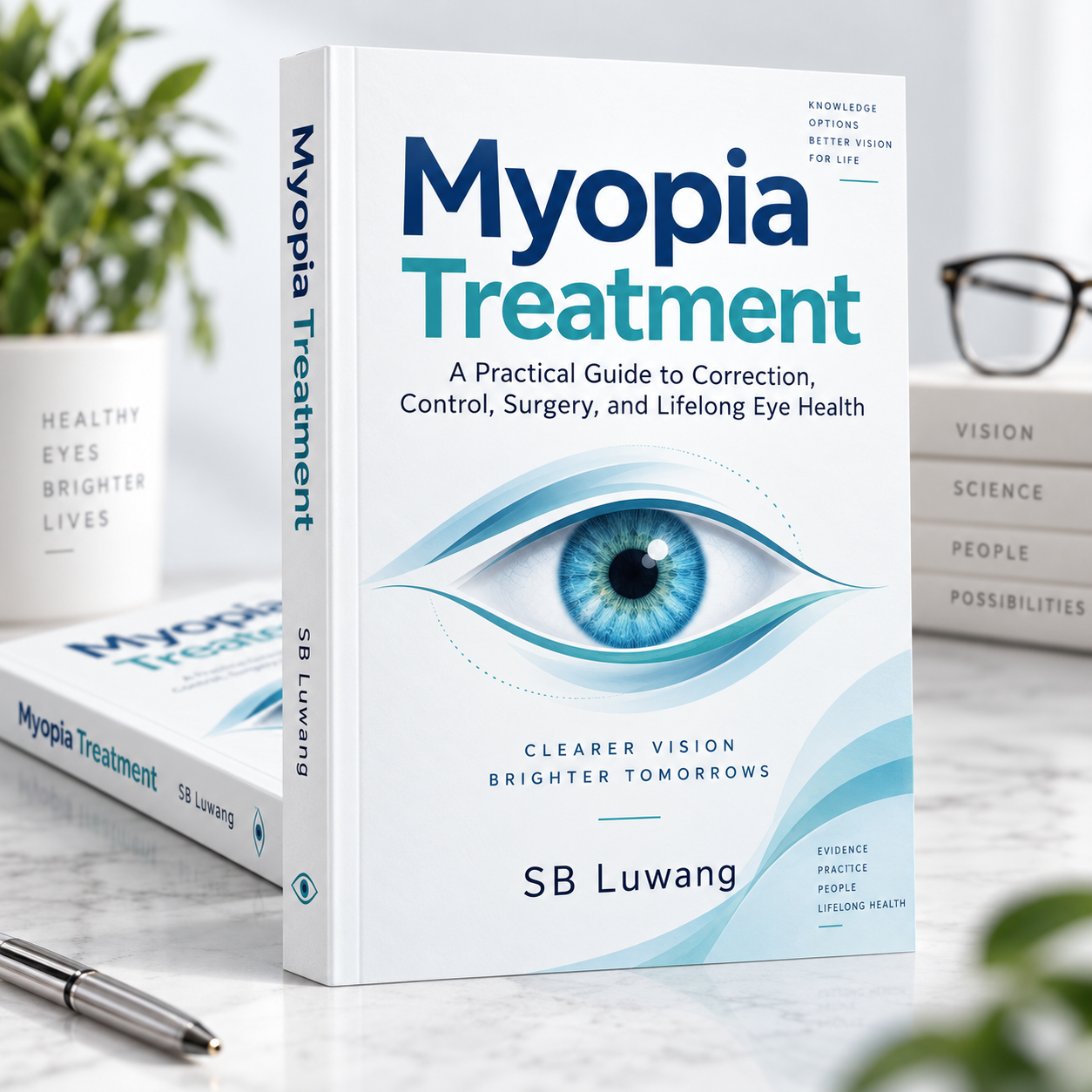
Understand Myopia. Explore the Options. Protect Vision for Life.
Myopia, commonly called nearsightedness or short-sightedness, is more than simply needing stronger glasses.
For many people—especially children—myopia is associated with continued growth and elongation of the eye. While spectacles or contact lenses can make blurred distance vision clear, modern eye care also considers whether progression can be slowed and how long-term eye health can be protected.
Myopia Treatment by SB Luwang is a comprehensive yet easy-to-understand guide to the science, correction, treatment, and lifelong management of myopia.
The book separates three questions that are often confused:
How can my vision be made clear?
How can myopia progression be slowed?
How can the eye be protected over the long term?
This distinction helps readers understand what different treatments actually achieve and avoid exaggerated claims about permanent “cures.”
What You Will Learn
The book explains:
- What myopia is and why distant objects become blurred
- How axial length affects myopia
- Why myopia often begins and progresses during childhood
- Genetics, outdoor activity, near work, and screen use
- How ophthalmologists and optometrists diagnose myopia
- How to understand an eyeglass prescription
- Standard eyeglasses and contact lenses
- Myopia-control spectacle lenses
- Dual-focus and multifocal contact lenses
- Orthokeratology or Ortho-K
- Atropine eye drops
- Outdoor time and healthier near-work habits
- Combining and monitoring myopia-control treatments
- Eye exercises and common “natural cure” claims
- Vitamins, supplements, and blue-light glasses
- Repeated low-level red-light therapy and emerging research
- Myopia during adolescence and young adulthood
- High myopia and its long-term risks
- LASIK
- PRK
- SMILE
- Implantable collamer and other phakic lenses
- Pregnancy-related changes in vision
- Retinal tears and retinal detachment
- Glaucoma, cataract, and myopic macular disease
- Warning signs that require urgent medical attention
Special Practical Features
The book includes useful tools for patients and families, including:
- Parent’s Myopia Action Plan
- Questions to Ask Your Eye Doctor
- Treatment comparison tables
- Axial-length tracking sheets
- Prescription progress records
- Contact-lens safety checklists
- Atropine treatment records
- High-myopia emergency warning guide
- Refractive-surgery question checklist
- Comprehensive FAQ section
- Medical terminology glossary
- Consolidated references and further reading
For Parents of Children with Progressive Myopia
Parents frequently hear conflicting advice about children’s myopia.
Should a child wear glasses all day?
Can smartphones cause myopia?
Will glasses make the eyes weaker?
Can atropine stop progression?
Are myopia-control glasses worth considering?
Is Ortho-K safe?
Can children wear contact lenses?
Does outdoor activity really help?
This book addresses these questions in practical language while separating established evidence from advertising claims.
A Detailed Guide to Myopia-Control Options
Modern myopia management offers several approaches.
The book explains the principles, advantages, limitations, safety considerations, and evidence behind:
Myopia-Control Spectacles
Specialized lenses designed to provide clear vision while altering retinal optics associated with eye growth.
Soft Myopia-Control Contact Lenses
Dual-focus and multifocal designs intended to correct vision while slowing progression.
Orthokeratology
Special rigid lenses generally worn overnight to temporarily reshape the cornea while also providing a myopia-control effect.
Atropine Eye Drops
A pharmacological approach studied extensively for reducing childhood myopia progression.
Combination Treatment
Why some children may require more than one strategy and why “more treatment” does not automatically mean better treatment.
Refractive Surgery Explained Clearly
For adults considering freedom from spectacles, the book discusses:
- LASIK
- PRK
- SMILE
- Phakic intraocular lenses
- Implantable collamer lenses
Readers learn an especially important distinction:
Refractive surgery can correct myopic focus, but it does not shorten an elongated eyeball.
A person who had high myopia before surgery may therefore still require appropriate retinal monitoring even if they no longer need distance glasses.
High Myopia and Retinal Health
High myopia can increase the lifetime risk of certain eye conditions.
The book explains:
- Retinal tears
- Retinal detachment
- Myopic maculopathy
- Choroidal neovascularization
- Posterior staphyloma
- Glaucoma
- Cataract
- Myopic traction maculopathy
Readers also learn the major emergency warning signs:
Sudden new floaters.
Flashes of light.
A curtain or shadow in vision.
Sudden central distortion.
Sudden loss of vision.
These symptoms require prompt professional assessment.
Evidence-Based Without Being Overly Technical
Medical information can often become difficult to understand.
This book uses:
- plain-English explanations;
- diagrams;
- practical examples;
- comparison tables;
- checklists;
- evidence boxes;
- summaries at the end of chapters.
Technical terms such as axial length, cycloplegic refraction, peripheral defocus, orthokeratology, retinal detachment, and corneal ectasia are explained before being used in greater detail.
Who Is This Book For?
This book is suitable for:
- Parents of children with myopia
- Teenagers and young adults with progressing prescriptions
- Adults with high myopia
- People considering LASIK, PRK, SMILE, or implantable lenses
- Teachers and caregivers
- Optometry and ophthalmology students seeking an accessible overview
- General readers interested in eye health
Important Note
This book is intended for educational purposes and does not replace examination, diagnosis, prescription, or treatment by a qualified ophthalmologist, optometrist, or other licensed eye-care professional.
Medication, contact lenses, orthokeratology, refractive surgery, and other treatments require individualized professional assessment.



Reviews
There are no reviews yet.