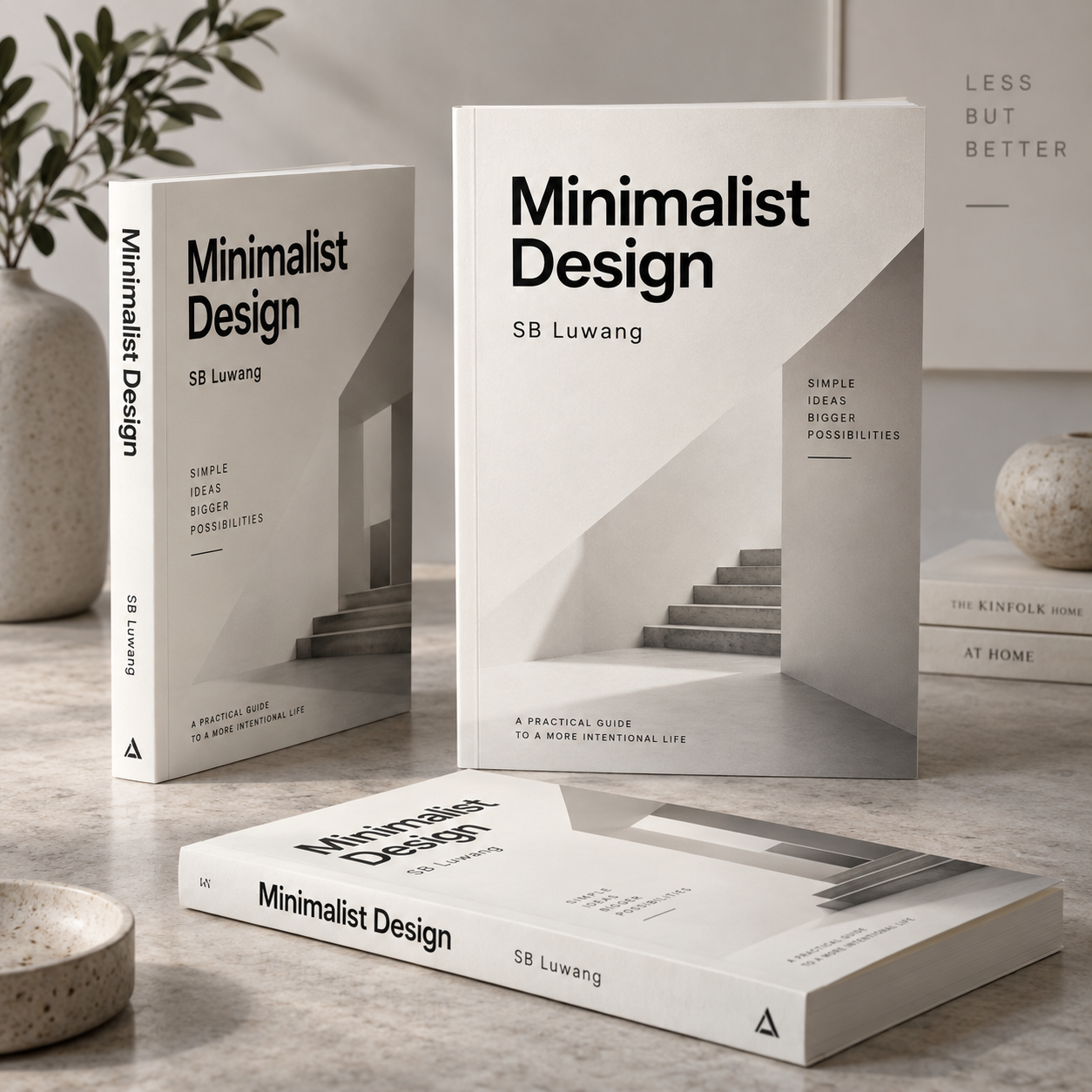
Good minimalist design is not about making things empty. It is about making every remaining element matter.
Minimalist Design is a practical introduction to creating visual work that is clear, purposeful, balanced, and functional.
Author SB Luwang takes readers beyond the common idea that minimalism simply means white backgrounds and fewer elements. Instead, the book presents minimalism as a complete design method based on hierarchy, intentional reduction, proportion, spacing, typography, color, imagery, grids, and usability.
The book begins with the foundations of minimalist thinking and gradually moves into practical applications for both print and digital design.
Readers will learn how to simplify cluttered layouts, create stronger hierarchy, use white space effectively, select and combine typefaces, build restrained color systems, choose better images, work with grids, and create consistent visual identities.
The book also applies these principles to real design formats including posters, flyers, brochures, business cards, letterheads, packaging, book covers, websites, landing pages, mobile interfaces, dashboards, social media graphics, and branding systems.
What You Will Learn
- Understand the principles behind minimalist design
- Create strong visual hierarchy
- Use white space and negative space intentionally
- Improve composition, alignment, balance, and proportion
- Choose and combine typefaces effectively
- Build practical type scales and typography systems
- Create minimalist color palettes
- Use accent colors without overwhelming the design
- Select, crop, and position images more effectively
- Design consistent icons, shapes, and illustrations
- Build column, modular, and baseline grids
- Create better posters, brochures, packaging, and book covers
- Apply minimalism to websites and mobile interfaces
- Simplify forms, navigation, dashboards, and calls to action
- Build complete minimalist brand systems
- Audit and refine existing designs
- Develop your own personal design style
Practical Learning
The book contains numerous exercises and complete design projects that allow readers to apply each principle immediately.
Projects include:
- One-word typographic poster
- Minimal event poster
- Business card
- Typographic book cover
- Editorial spread
- Minimal brand palette
- One-color poster
- Single-image advertisement
- Icon set
- Geometric poster
- Magazine spread
- Responsive landing page
- Complete print identity
- Service website
- Analytics dashboard
- Complete minimalist brand system
The final chapters include complete case studies that demonstrate how a project develops from brief → hierarchy → grid → typography → color → imagery → reduction → refinement.
Also Included
- 100 Minimalist Design Rules
- Master minimalist design checklist
- Typography and color troubleshooting guides
- Grid and layout exercises
- Branding audits
- Practical design exercises
- Design glossary
- Recommended areas for further study
Who This Book Is For
This book is suitable for:
- Graphic design beginners
- Design students
- Freelance designers
- Print designers
- UI and web designers
- Social media designers
- Content creators
- Small-business owners
- Marketing professionals
- Publishers and book designers
- Anyone who wants to improve visual communication
No advanced design knowledge is required.


Reviews
There are no reviews yet.