Discover How Light Can Reconstruct Reality
Holography is far more than the floating images commonly shown in science fiction.
At its core, holographic technology is the science of recording, calculating and reconstructing optical wavefronts.
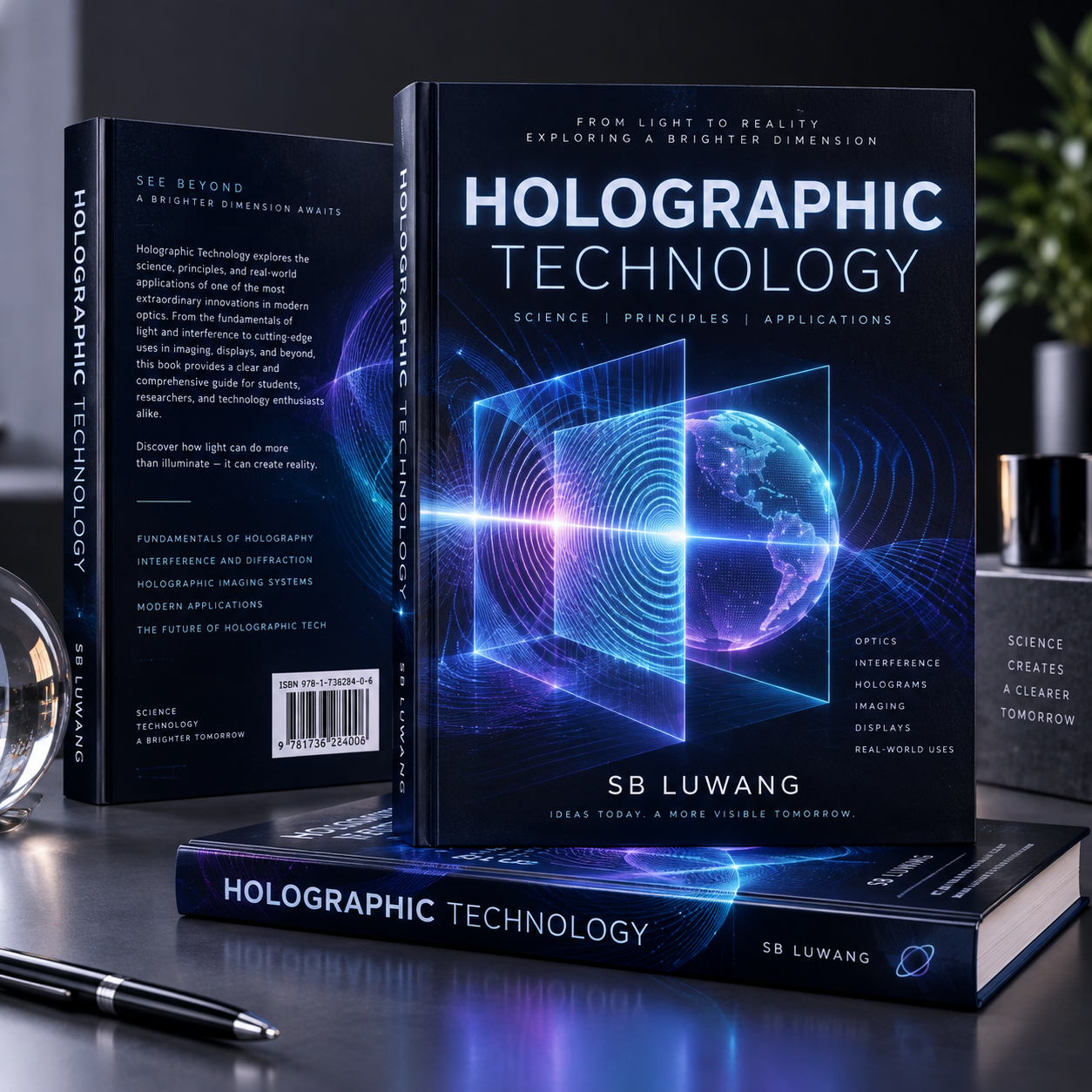
Holographic Technology by SB Luwang provides a structured introduction to the physics, engineering and emerging applications of this rapidly developing field.
Beginning with the fundamentals of light, wavelength, phase, coherence, interference and diffraction, the book gradually develops the concepts required to understand classical optical holography.
It then moves into modern technologies including digital holography, quantitative phase imaging, computer-generated holography, spatial light modulators, holographic displays, augmented and virtual reality, artificial intelligence and metasurface optics.
The explanations are supported by equations, conceptual diagrams, practical comparisons, technical examples and chapter review questions.
Inside the Book
Readers will explore:
- Fundamentals of holographic imaging
- Light, wavelength, phase and coherence
- Interference and diffraction
- Wavefront reconstruction
- Transmission and reflection holograms
- Rainbow and full-colour holography
- Holographic recording materials
- Digital holography
- Numerical wave propagation
- Fourier optics
- Quantitative phase imaging
- Digital holographic microscopy
- Computer-generated holography
- Gerchberg–Saxton and hologram optimisation
- Spatial light modulators
- Wavefront holographic displays
- Light-field and volumetric displays
- Holography in AR and VR
- Holographic optical elements
- Engineering and interferometric measurement
- Security holograms and anti-counterfeiting
- Holographic data storage
- Artificial intelligence in holography
- Neural holography
- Metasurface holography
- The limitations of holographic television
- Future applications of programmable wavefront technology
A Clear Distinction Between Real Holography and Marketing Claims
The book explains the important differences between:
Holography
Stereoscopic 3D
Light-field displays
Volumetric displays
Pepper’s Ghost
Transparent projection systems
Rotating LED “hologram” displays
This allows readers to understand the actual optical principles behind modern 3D technologies.
From Classical Holograms to AI
The book follows the development of holography from the pioneering work of Dennis Gabor to modern computational systems.
It examines how today’s holographic technologies combine:
Optics + Mathematics + Computer Graphics + Artificial Intelligence + Nanotechnology
Modern neural networks can help reconstruct holograms, estimate phase, generate computer-generated holograms and compensate for imperfections in real optical systems.
Metasurfaces and the Future of Optics
A dedicated section introduces metasurface holography—ultra-thin optical structures built from nanoscale elements capable of controlling light.
Readers will learn how metasurfaces may contribute to:
- AR glasses
- Compact optical systems
- Meta-holograms
- Metalenses
- Beam steering
- Security features
- Advanced sensors
- Future wearable displays
Holography in the Real World
The book also examines practical applications in:
- Microscopy
- Biomedical imaging
- Engineering measurement
- Vibration analysis
- Nondestructive testing
- Security printing
- Authentication
- Data storage
- Optical communication
- LiDAR
- Digital twins
- Spatial computing
Who Is This Book For?
Suitable for:
- Physics students
- Engineering students
- Optical engineering learners
- Electronics students
- Computer science students
- AR/VR developers
- Researchers
- Makers and technology enthusiasts
- Printing and security professionals
- Anyone interested in future display technology
No advanced background in optical engineering is required to begin reading.
Mathematical sections are introduced progressively and explained alongside the physical concepts.
Book Features
- 26 comprehensive chapters
- Approximately 277 professionally designed pages
- Mathematical equations and optical principles
- Technical diagrams and conceptual illustrations
- Chapter summaries
- Review questions
- Glossary of holographic terminology
- Fourier optics primer
- Laser-safety appendix
- Holographic technology timeline
- Selected bibliography and further reading
- Beginner-friendly explanations with technical depth




Reviews
There are no reviews yet.