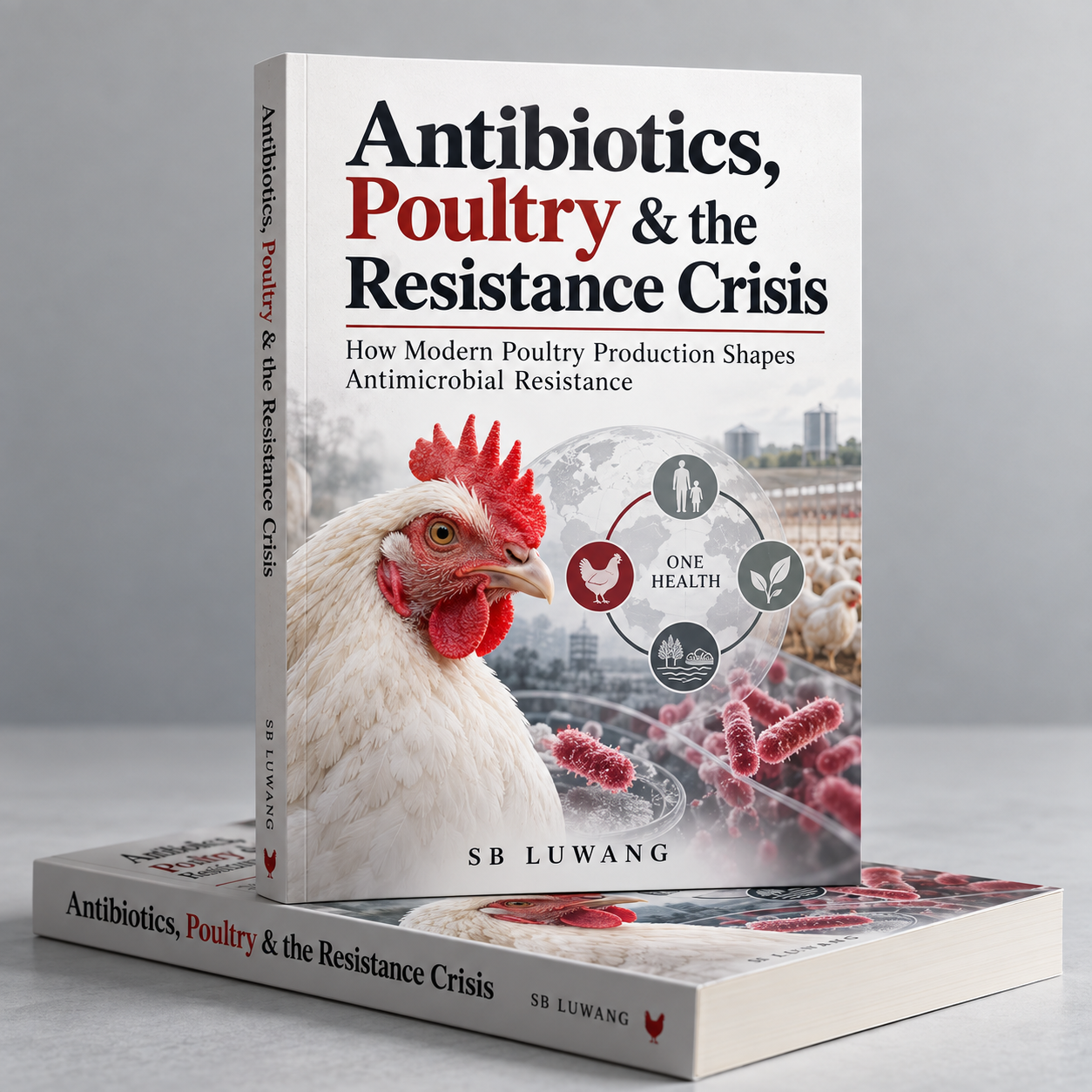
Antibiotics are among humanity’s most valuable medicines. Their effectiveness is not guaranteed forever.
Modern poultry farming has transformed food production, making chicken and eggs affordable to billions of people. Antibiotics have also played an important role in protecting animal health.
But whenever antibiotics are used unnecessarily, bacterial populations are given another opportunity to evolve resistance.
Antibiotics, Poultry & the Resistance Crisis examines this challenge without blaming farmers, frightening consumers, or arguing that veterinary antibiotics should disappear.
Instead, author SB Luwang presents antimicrobial resistance as a connected One Health problem involving animals, humans, food, hospitals, agriculture, wastewater, and the wider environment.
The book explains how resistant bacteria emerge, how resistance genes move between organisms, how poultry-associated bacteria may travel through the food chain, and why antimicrobial effectiveness must be treated as a shared biological resource.
Inside the Book
Readers will explore:
- How antibiotics changed human and veterinary medicine
- How bacterial resistance evolves
- Why poultry farms use antibiotics
- The difference between antibiotic use, residues, resistant bacteria, and resistance genes
- The poultry gut microbiome and resistome
- Plasmids and horizontal gene transfer
- ESBL-producing bacteria
- Fluoroquinolone resistance
- Colistin and the mcr resistance-gene warning
- Farm-worker occupational exposure
- Slaughterhouse and retail-meat contamination pathways
- Kitchen cross-contamination
- Poultry litter, manure, soil, and water
- Wastewater and environmental AMR
- India’s poultry industry and antimicrobial-resistance evidence
- Antibiotic resistance in Indian retail chicken
- A Northeast India poultry case study
- India’s 2019 colistin regulation
- FSSAI residue and food-safety regulations
- India’s NAP-AMR 2.0 for 2025–2029
- Resistant infections in hospitals
- Gram-negative antimicrobial resistance
- Why surgery, chemotherapy, transplantation, and intensive care depend on effective antibiotics
- The global human cost of AMR
- Biosecurity and better poultry housing
- Water, feed, and litter management
- Vaccination
- Veterinary diagnostics
- Responsible antimicrobial treatment
- Farm treatment records and traceability
- Probiotics and prebiotics
- Organic acids and phytogenic feed additives
- Bacteriophages and emerging technologies
- Economic reasons farmers depend on antibiotics
- How farms can transition away from routine antibiotic use without sacrificing animal welfare
- Food labels such as “raised without antibiotics”
- Integrated farm-to-hospital surveillance
- A practical One Health policy blueprint
Special Practical Appendices
The book also includes:
- Comprehensive AMR glossary
- Major antibiotic-class reference guide
- Poultry AMR surveillance checklist
- Farm antimicrobial-use record template
- Biosecurity self-audit
- India AMR policy timeline
- Consolidated scientific references
- AMR myth-checking guide
- One-page poultry stewardship checklist
A Balanced Approach to Poultry and Antibiotics
This book does not argue that all poultry is dangerous.
It does not claim that agriculture causes every resistant human infection.
It does not confuse antibiotic residues with antimicrobial resistance.
And it does not recommend denying treatment to sick animals.
Its central argument is simpler:
Build healthier poultry systems that need antibiotics less, while preserving effective treatment for situations in which antibiotics genuinely save animal or human lives.
Who Should Read This Book?
Ideal for:
- Poultry farmers
- Veterinarians
- Veterinary students
- Agriculture students
- Public-health students
- Food-safety professionals
- Poultry industry professionals
- Researchers
- Policymakers
- Environmental-health professionals
- Medical professionals interested in One Health
- Journalists covering agriculture or AMR
- Educated consumers interested in food safety




Reviews
There are no reviews yet.