- +91-9774991814
- Usha Cinema Hall, Paoana Bazar, Imphal
- 9 AM - 6 PM

Certificate Course in Inventory Management for Printing & Packaging Industry
About Course
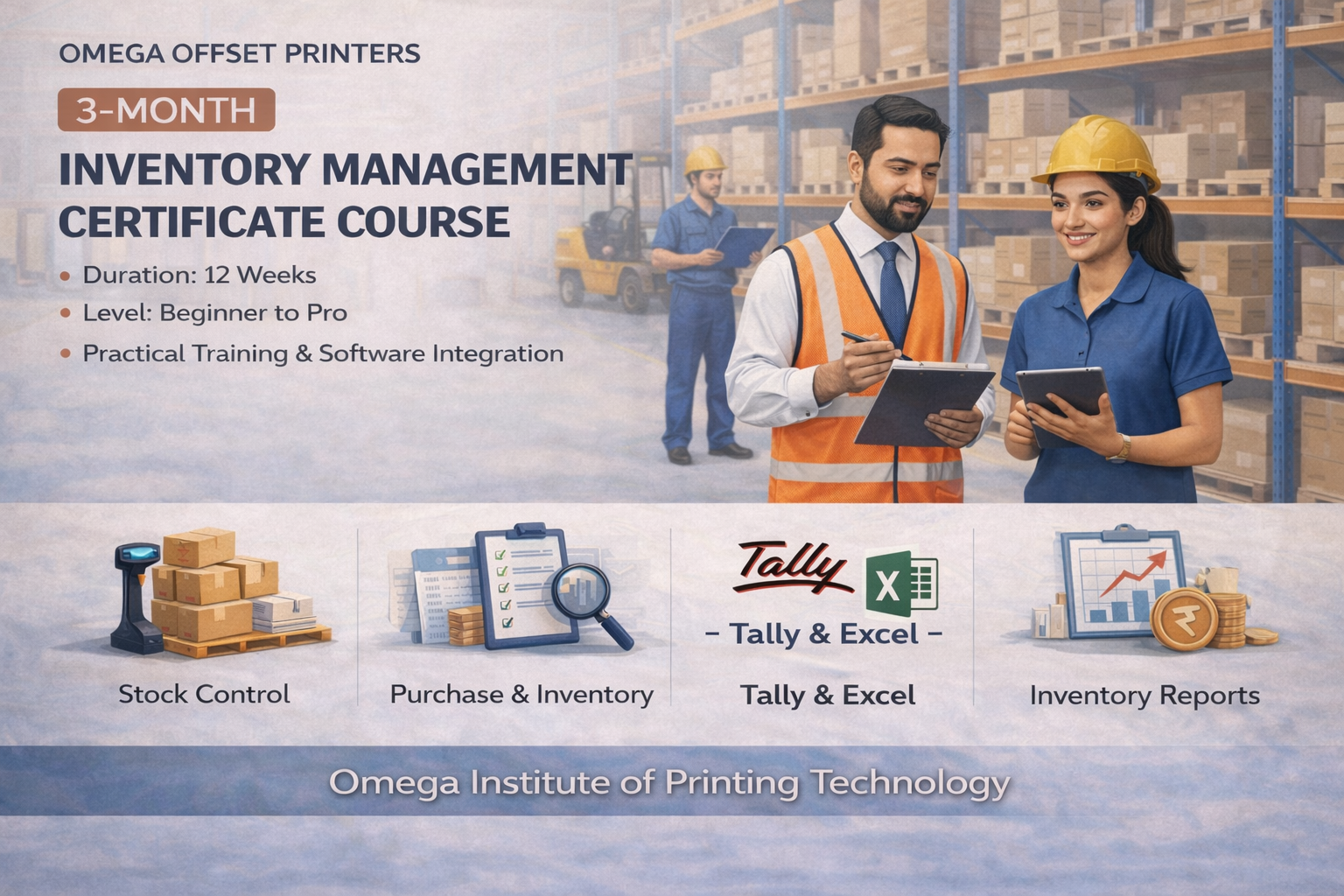
This 3-month professional program is designed to provide practical and strategic training in inventory management specifically for printing, signage, packaging, and production-based industries.
The course combines warehouse practice, stock control systems, Excel-based tracking, and Tally Prime integration to build real-world skills. Participants will learn how to manage paper, ink, consumables, signage materials, finished goods, and multi-branch stock operations efficiently.
The program focuses on operational accuracy, cost control, wastage reduction, audit compliance, and performance monitoring to support business growth and financial stability.
What Will You Learn?
- Understand inventory types in printing & packaging industry
- Apply ABC, FSN, HML, and VED classification
- Calculate EOQ, reorder level, minimum & maximum stock
- Manage purchase planning and vendor evaluation
- Maintain documentation (PO, GRN, Issue Slip, Transfer Note)
- Design Excel-based inventory tracking systems
- Integrate inventory with Tally Prime
- Monitor wastage and improve material efficiency
- Conduct physical verification and stock audit
- Measure KPIs like turnover ratio and holding period
- Manage multi-branch inventory coordination
- Develop strategic inventory planning models
Course Content
Chapter 1: Introduction to Inventory Management in the Printing Industry
-
1.1 Introduction
-
1.2 Meaning of Inventory
-
1.3 Types of Inventory at Omega Offset Printers
-
1.4 Importance of Inventory Management in Printing Industry
-
1.5 Objectives of Inventory Management
-
1.6 Characteristics of Printing Industry Inventory
-
1.7 Printing Industry Inventory Flow System
-
1.8 Inventory Terminology
-
1.9 Role of Inventory Manager at Omega
-
1.10 Inventory Challenges in Printing Industry
-
1.11 Practical Case Study – Omega Offset Printers
-
1.12 Inventory as a Strategic Asset
-
1.13 Summary of Chapter 1
-
1.14 Practice Questions
Chapter 2: Classification of Inventory in Printing & Signage Industry
-
2.1 Introduction
-
2.2 Need for Inventory Classification
-
2.3 ABC Analysis
-
2.4 How to Perform ABC Analysis
-
2.5 FSN Analysis (Fast, Slow, Non-Moving)
-
2.6 HML Analysis (High, Medium, Low Cost)
-
2.7 VED Analysis (Vital, Essential, Desirable)
-
2.8 Combined Classification Approach
-
2.9 Inventory Categorization at Omega Offset Printers
-
2.10 Benefits of Proper Classification
-
2.11 Case Study – Omega Scenario
-
2.12 Future-Oriented Inventory Strategy
-
2.13 Summary
-
2.14 Practice Questions
Chapter 3: Inventory Costs and Financial Impact in Printing Industry
-
3.1 Introduction
-
3.2 Types of Inventory Costs
-
3.3 Purchase Cost
-
3.4 Ordering Cost
-
3.5 Carrying (Holding) Cost
-
3.6 Stockout Cost
-
3.7 Obsolescence Cost
-
3.8 Economic Order Quantity (EOQ)
-
3.9 Total Inventory Cost Concept
-
3.10 Financial Impact on Omega Offset Printers
-
3.11 Inventory Cost Control Strategies
-
3.12 Case Study – Omega Scenario
-
3.13 Inventory Cost & Accounts Integration
-
3.14 Forward Strategy for Omega
-
3.15 Summary
-
3.16 Practice Questions
Chapter 4: Stock Levels and Reorder Planning in Printing Industry
-
4.1 Introduction
-
4.2 Importance of Stock Level Planning
-
4.3 Key Concepts in Stock Control
-
4.4 Reorder Level
-
4.5 Minimum Stock Level
-
4.6 Maximum Stock Level
-
4.7 Safety Stock (Buffer Stock)
-
4.8 Visual Stock Control System
-
4.9 Stock Level Planning for Different Materials at Omega
-
4.10 Lead Time Analysis
-
4.11 Stock Card System
-
4.12 Common Mistakes in Stock Level Planning
-
4.13 Case Study – Omega Scenario
-
4.14 Advanced Techniques for Future Expansion
-
4.15 Summary
-
4.16 Practice Questions
Chapter 5: Inventory Documentation & Record Management System
-
5.1 Introduction
-
5.2 Importance of Inventory Documentation
-
5.3 Purchase Order (PO)
-
5.4 Goods Receipt Note (GRN)
-
5.5 Stock Register
-
5.6 Bin Card System
-
5.7 Material Issue Slip
-
5.8 Material Return Slip
-
5.9 Inter-Branch Transfer Note
-
5.10 Digital Inventory Documentation
-
5.11 Inventory Audit Trail
-
5.12 Common Documentation Errors
-
5.13 Case Study – Omega Scenario
-
5.14 Best Practices for Omega Inventory Documentation
-
5.15 Future-Ready Documentation System
-
5.16 Summary
-
5.17 Practice Questions
Chapter 6: Store Layout, Warehouse Planning & Material Handling System
-
6.1 Introduction
-
6.2 Objectives of Proper Store Layout
-
6.3 Types of Store Layout in Printing Industry
-
6.4 Store Zoning at Omega Offset Printers
-
6.5 Paper Storage Guidelines
-
6.6 Ink & Chemical Storage
-
6.7 Acrylic & Vinyl Handling
-
6.8 Material Handling Equipment
-
6.9 Safety Measures in Store
-
6.10 Warehouse Layout Planning Steps
-
6.11 5S System for Store Management
-
6.12 Common Store Layout Mistakes
-
6.13 Case Study – Omega Scenario
-
6.14 Future-Ready Store System for Omega
-
6.15 Summary
-
6.16 Practice Questions
Chapter 7: Inventory Control Techniques in Printing & Signage Industry
-
7.1 Introduction
-
7.2 FIFO – First In First Out
-
7.3 LIFO – Last In First Out
-
7.4 EOQ – Economic Order Quantity
-
7.5 Just In Time (JIT)
-
7.6 Perpetual Inventory System
-
7.7 Two-Bin System
-
7.8 Inventory Turnover Ratio
-
7.9 Safety Stock Control
-
7.10 Cycle Counting
-
7.11 Control of High-Value Items
-
7.12 Wastage Control Technique
-
7.13 Case Study – Omega Scenario
-
7.14 Integrated Control Model for Omega
-
7.15 Summary
-
7.16 Practice Questions
Chapter 8: Excel-Based Inventory Management System
-
8.1 Introduction
-
8.2 Why Excel for Inventory?
-
8.3 Structure of Excel Inventory Workbook
-
8.4 Master Data Sheet
-
8.5 Purchase Entry Sheet
-
8.6 Issue Entry Sheet
-
8.7 Stock Calculation Formula
-
8.8 Reorder Alert System
-
8.9 Wastage Monitoring System
-
8.10 Monthly Consumption Report
-
8.11 Dashboard Creation
-
8.12 Barcode Integration (Advanced Level)
-
8.13 Branch-Wise Inventory Consolidation
-
8.14 Data Validation & Control
-
8.15 Common Excel Mistakes
-
8.16 Case Study – Omega Scenario
-
8.17 Advantages of Excel-Based System at Omega
-
8.18 Future Digital Strategy
-
8.19 Summary
-
8.20 Practice Assignment
Chapter 9: Tally Prime Integration for Inventory Management
-
9.1 Introduction
-
9.2 Why Integrate Inventory with Accounting?
-
9.3 Enabling Inventory in Tally Prime
-
9.4 Creating Stock Groups
-
9.5 Creating Stock Items
-
9.6 Units of Measurement
-
9.7 Multiple Godown Setup
-
9.8 Purchase Entry in Tally
-
9.9 Sales Entry in Tally
-
9.10 Manufacturing / Job Work Entry
-
9.11 Batch-Wise Management
-
9.12 Stock Reports in Tally Prime
-
9.13 Stock Valuation Methods
-
9.14 Inventory & GST Integration
-
9.15 Reorder Level Setup
-
9.16 Common Errors in Tally Inventory
-
9.17 Physical Verification in Tally
-
9.18 Case Study – Omega Scenario
-
9.19 Advanced Integration for Future Growth
-
9.20 Summary
-
9.21 Practice Assignment
Chapter 10: Wastage Control & Material Efficiency in Printing Industry
-
10.1 Introduction
-
10.2 Meaning of Wastage
-
10.3 Types of Wastage in Printing Industry
-
10.4 Causes of Wastage
-
10.5 Standard Wastage Percentage
-
10.6 Wastage Calculation Formula
-
10.7 Paper Wastage Control Techniques
-
10.8 Ink Wastage Control
-
10.9 Vinyl & Acrylic Wastage Control
-
10.10 Wastage Monitoring System at Omega
-
10.11 Wastage Reporting Format
-
10.12 Scrap Management
-
10.13 Cost Impact of Wastage
-
10.14 Performance Monitoring
-
10.15 Case Study – Omega Scenario
-
10.16 Technology-Based Wastage Control
-
10.17 Summary
-
10.18 Practice Questions
Chapter 11: Purchase Planning & Vendor Management in Printing Industry
-
11.1 Introduction
-
11.2 Objectives of Purchase Planning
-
11.3 Steps in Purchase Planning
-
11.4 Types of Purchases at Omega
-
11.5 Vendor Evaluation Criteria
-
11.6 Annual Purchase Planning
-
11.7 Economic Order Quantity in Purchase Planning
-
11.8 Negotiation Strategy
-
11.9 Purchase Documentation Process
-
11.10 Vendor Rating System
-
11.11 Risk Management in Purchasing
-
11.12 Ethical Purchasing Practices
-
11.13 Case Study – Omega Scenario
-
11.14 Technology in Purchase Planning
-
11.15 Integration with Finance & Inventory
-
11.16 Forward Growth Strategy for Omega
-
11.17 Summary
-
11.18 Practice Questions
Chapter 12: Branch Inventory Coordination & Centralized Control System
-
12.1 Introduction
-
12.2 Why Branch Inventory Coordination is Important
-
12.3 Types of Inventory Structure in Multi-Branch Setup
-
12.4 Centralized Purchase Control
-
12.5 Inter-Branch Transfer System
-
12.6 Inter-Branch Transfer Documentation
-
12.7 Multi-Godown Setup in Tally Prime
-
12.8 Branch Stock Reporting System
-
12.9 Stock Balancing Strategy
-
12.10 Transportation & Logistics Planning
-
12.11 Branch-Level Reorder Policy
-
12.12 Common Multi-Branch Problems
-
12.13 Branch Performance Indicators
-
12.14 Case Study – Omega Scenario
-
12.15 Digital Central Monitoring System
-
12.16 Risk Control in Multi-Branch Inventory
-
12.17 Integration with Finance
-
12.18 Growth Strategy for Omega
-
12.19 Summary
-
12.20 Practice Questions
Chapter 13: Inventory Audit, Physical Verification & Compliance Management
-
13.1 Introduction
-
13.2 Meaning of Inventory Audit
-
13.3 Types of Inventory Audit
-
13.4 Objectives of Inventory Audit
-
13.5 Physical Stock Verification Process
-
13.6 Methods of Stock Verification
-
13.7 Causes of Stock Discrepancy
-
13.8 Stock Adjustment Entry
-
13.9 Inventory Valuation Methods
-
13.10 Audit Checklist for Omega
-
13.11 Dead Stock & Obsolete Inventory Review
-
13.12 Audit of High-Value Items
-
13.13 Risk Management in Inventory Audit
-
13.14 Internal Control System
-
13.15 Case Study – Omega Scenario
-
13.16 Compliance with Financial Reporting
-
13.17 Technology for Audit Improvement
-
13.18 Summary
-
13.19 Practice Questions
Chapter 14: Inventory Performance Measurement & KPI Analysis
-
14.1 Introduction
-
14.2 Why KPI Measurement is Important
-
14.3 Key Inventory KPIs for Omega
-
14.4 KPI Dashboard System
-
14.5 Department-Wise Performance Analysis
-
14.6 Branch-Wise KPI Monitoring
-
14.7 Financial Impact of KPIs
-
14.8 Benchmark Targets for Omega
-
14.9 Continuous Improvement Strategy
-
14.10 Case Study – Omega Scenario
-
14.11 Linking KPI with Employee Performance
-
14.12 Technology for KPI Monitoring
-
14.13 Strategic Role of Inventory in Growth
-
14.14 Summary
-
14.15 Practice Questions
Chapter 15: Strategic Inventory Planning & Organizational Growth
-
15.1 Introduction
-
15.2 Strategic Role of Inventory in Business Growth
-
15.3 Long-Term Inventory Planning Framework
-
15.4 Strategic Inventory Policies
-
15.5 Technology Roadmap for Inventory Modernization
-
15.6 Working Capital Optimization Strategy
-
15.7 Risk Management Strategy
-
15.8 Sustainability & Environmental Responsibility
-
15.9 Integration with Organizational Strategy
-
15.10 Expansion Scenario Planning
-
15.11 Performance-Based Culture
-
15.12 Final Integrated Model for Omega
-
15.13 Case Study – Strategic Transformation
-
15.14 Future Vision for Omega Offset Printers
-
15.15 Summary of Entire Course
-
15.16 Final Project Assignment
-
5.17 Final Message
Student Ratings & Reviews

No Review Yet