- +91-9774991814
- Usha Cinema Hall, Paoana Bazar, Imphal
- 9 AM - 6 PM

Screen Printing Technology (3 Months)
Categories: CERTIFICATE COURSE
About Course
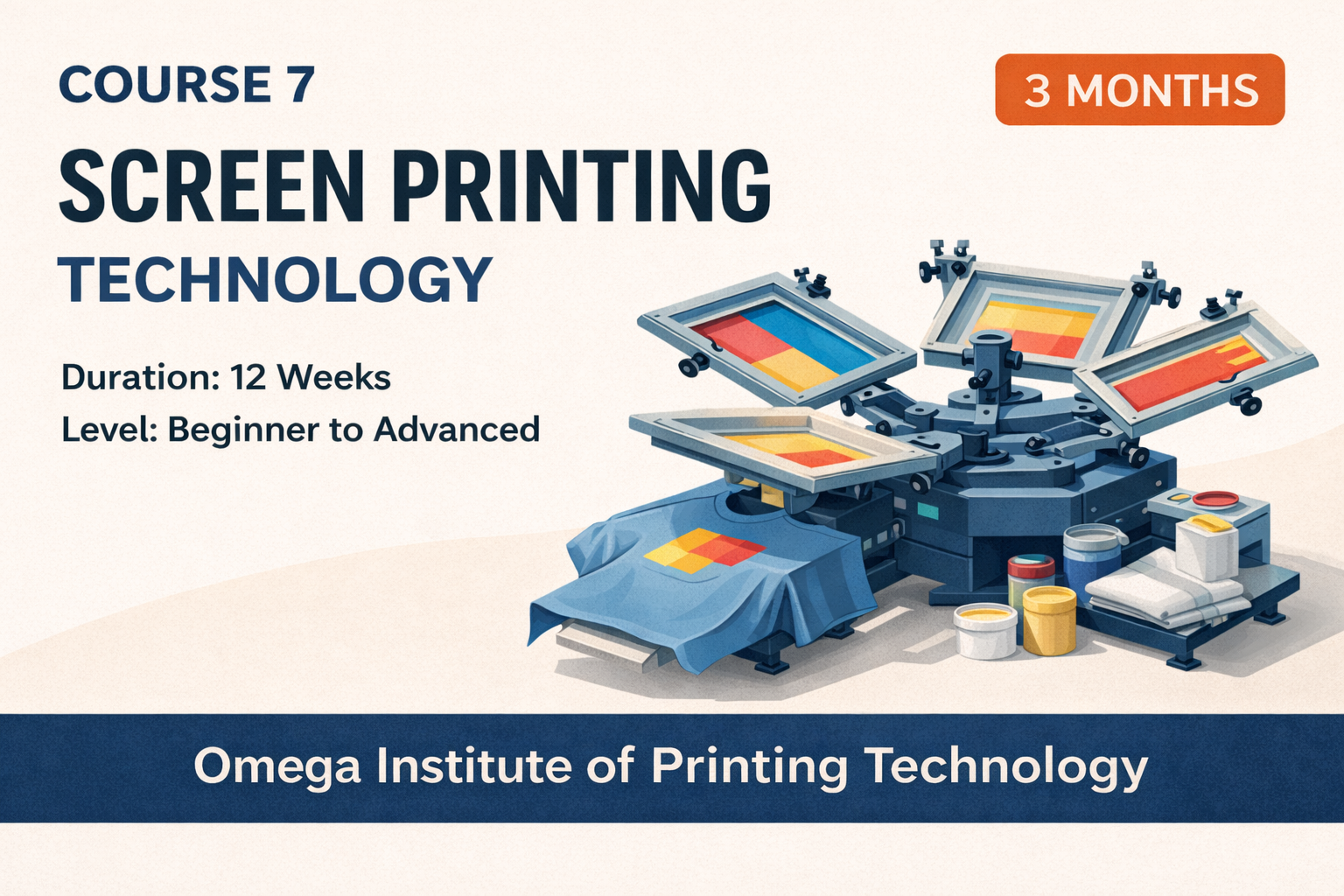
This course provides complete hands-on training in Screen Printing Technology, covering paper printing, fabric & T-shirt printing, multicolour registration, and advanced UV screen printing techniques. Designed for real production environments, the program takes learners from basic screen preparation to professional-level printing, troubleshooting, and workflow management.
Students will learn how to prepare screens, create stencils, print single and multicolour designs, apply underbase techniques for garments, execute spot UV and texture UV on paper, and manage production jobs efficiently. The course is fully aligned with commercial printing press and garment unit requirements.
By the end of the program, learners will be industry-ready screen printing technicians capable of handling bulk orders with quality and confidence.
What Will You Learn?
- Understand the fundamentals of screen printing and its applications
- Prepare artwork suitable for screen printing
- Make professional screens using emulsion and exposure techniques
- Select correct mesh counts for paper, fabric, and UV jobs
- Print single-colour and multicolour designs accurately
- Perform T-shirt printing with underbase and flash curing
- Print on fabric, paper, vinyl, and boards
- Apply gloss, matt, spot UV, high-build and texture UV effects
- Register multi-screen jobs with precision
- Troubleshoot common printing defects
- Maintain screens, inks, and printing equipment
- Plan production workflow for bulk orders
- Build a professional print portfolio
Course Content
CHAPTER 1 — INTRODUCTION TO SCREEN PRINTING
-
1.0
-
1.1 What Is Screen Printing?
-
1.2 History and Evolution of Screen Printing
-
1.3 Screen Printing vs Offset vs Digital
-
1.4 Applications of Screen Printing
-
1.5 Basic Components of Screen Printing
-
1.6 Advantages of Screen Printing
-
1.7 Limitations of Screen Printing
-
1.8 The Screen Printing Workflow
-
1.9 Substrates Used in Screen Printing
-
1.10 Safety and Workspace Setup
-
1.11 Introduction to UV Screen Printing
-
1.12 Screen Printing in the Garment Industry
-
1.13 Why Screen Printing Is Still Relevant
-
1.14 Summary of Key Concepts
CHAPTER 2 — TOOLS, MATERIALS & SAFETY
-
2.0
-
2.1 Overview of Tools Required in Screen Printing
-
2.2 Screens & Frames
-
2.3 Mesh and Mesh Counts
-
2.4 Squeegees
-
2.5 Emulsion & Stencils
-
2.6 Coating Tools
-
2.7 Exposure Unit
-
2.8 Chemicals Used in Screen Printing
-
2.9 Inks Used in Screen Printing
-
2.10 Printing Platforms & Tools
-
2.11 Safety Equipment
-
2.12 Workspace Organization
-
2.13 Safety Procedures in Chemical Handling
-
2.14 Accident Prevention in the Workshop
-
2.15 Quality Considerations for Tools
-
2.16 Summary
CHAPTER 3 — ARTWORK PREPARATION
-
3.0
-
3.1 Understanding the Requirements of Screen Printing Artwork
-
3.2 Types of Artwork Used in Screen Printing
-
3.3 Artwork Resolution Requirements
-
3.4 Line Thickness Requirements
-
3.5 Positive Films: Inkjet vs Laser
-
3.6 How to Create Positive Films (Process)
-
3.7 Halftones for Screen Printing
-
3.8 Mirroring the Artwork
-
3.9 Adding Registration Marks
-
3.10 Colour Separation for Multicolour Designs
-
3.11 Artwork Preparation for Fabric Printing
-
3.12 Artwork Preparation for Paper Printing & UV Spot Varnish
-
3.13 Artwork for Stickers, Vinyl & Plastic
-
3.14 Preparing Artwork for Exposure
-
3.15 Common Mistakes in Artwork Preparation
-
3.16 Summary
CHAPTER 4 — SCREEN COATING & EXPOSURE
-
4.0
-
4.1 Understanding the Screen Stencil
-
4.2 Preparing the Screen Before Coating
-
4.3 Types of Emulsion & When to Use Them
-
4.4 Mixing The Emulsion (If Sensitizer Is Required)
-
4.5 Screen Coating Techniques
-
4.6 Drying the Coated Screen
-
4.7 Preparing for Exposure
-
4.8 Exposure Process
-
4.9 Under-Exposure vs Over-Exposure
-
4.10 Washout (Developing the Stencil)
-
4.11 Drying After Washout
-
4.12 Touch-Up & Pinholes
-
4.13 Hardening & Post-Exposure
-
4.14 Common Screen Coating & Exposure Problems
-
4.15 Importance of a Good Stencil
-
4.16 Summary
CHAPTER 5 — SCREEN REGISTRATION & SETUP
-
5.0
-
5.1 What Is Registration?
-
5.2 Components Involved in Registration
-
5.3 Understanding Off-Contact Distance
-
5.4 Setting Up the Screen on the Printing Table
-
5.5 Registration for Single-Colour Printing
-
5.6 Registration for Two-Colour and Multicolour Printing
-
5.7 Registration on Fabric (T-Shirt Boards)
-
5.8 Registration on Paper (Spot UV, Posters, Cards)
-
5.9 Screen Tension and Its Effect on Registration
-
5.10 Setting Up T-Shirt Boards (Pallets)
-
5.11 Calibrating Multi-Station Carousels
-
5.12 Checking Print Placement
-
5.13 The Snap-Off Effect
-
5.14 Troubleshooting Registration Issues
-
5.15 Professional Workflow for Registration
-
5.16 Summary
CHAPTER 6 — SINGLE COLOUR PRINTING
-
6.0
-
6.1 Overview of Single Colour Printing
-
6.2 Preparing for Printing
-
6.3 Ink Preparation
-
6.4 Understanding Squeegee Technique
-
6.5 Single Colour Printing on Paper
-
6.6 Single Colour Printing on Fabric
-
6.7 Printing on Vinyl, Stickers & Plastic
-
6.8 Maintaining Print Consistency
-
6.9 Drying and Curing the Print
-
6.10 Troubleshooting in Single Colour Printing
-
6.11 Quality Checking of Final Prints
-
6.12 Production Practice for Students
-
6.13 Summary
CHAPTER 7 — MULTICOLOUR PRINTING
-
7.0
-
7.1 Understanding Multicolour Screen Printing
-
7.2 Preparing Artwork for Multicolour Printing
-
7.3 Screens for Multicolour Work
-
7.4 Setting Up Multicolour Registration
-
7.5 Printing Order for Multicolour Jobs
-
7.6 Flash Curing Between Layers
-
7.7 Colour Mixing and Ink Behaviour
-
7.8 Multicolour Printing on Fabric
-
7.9 Multicolour Printing on Paper
-
7.10 Common Problems in Multicolour Printing
-
7.11 Consistency Across Multiple Colours
-
7.12 Practical Multicolour Projects for Students
-
7.13 Summary
CHAPTER 8 — FABRIC PRINTING (ADVANCED)
-
8.0
-
8.1 Introduction to Fabric Printing
-
8.2 Types of Fabrics Used in Screen Printing
-
8.3 Ink Systems for Fabric
-
8.4 Mesh Selection for Fabric Printing
-
8.5 Preparing the T-Shirt Board (Pallet)
-
8.6 Advanced Underbase Techniques
-
8.7 Flash Curing: The Most Important Step in Fabric Printing
-
8.8 Multicolour Fabric Printing Workflow (Advanced)
-
8.9 Special Effects in Fabric Printing
-
8.10 Curing Fabric Prints Properly
-
8.11 Quality Control in Garment Printing
-
8.12 Troubleshooting Advanced Fabric Printing
-
8.13 Practical Fabric Printing Projects for Students
-
8.14 Summary
CHAPTER 9 — PAPER & UV SCREEN PRINTING
-
9.0
-
9.1 Introduction to Paper & UV Screen Printing
-
9.2 Understanding Paper as a Substrate
-
9.3 Mesh Selection for Paper & UV
-
9.4 Inks & UV Varnishes for Paper
-
9.5 Registration for Paper & UV Jobs
-
9.6 Spot UV Printing Process
-
9.7 High-Build & Texture UV Printing
-
9.8 Printing Process for Paper (Normal Ink)
-
9.9 Drying & Curing for Paper Prints
-
9.10 Using UV Curing Lamps
-
9.11 Paper Handling & Quality Issues
-
9.12 UV Safety Precautions
-
9.13 Practical Paper & UV Projects for Students
-
9.14 Summary
CHAPTER 10 — TROUBLESHOOTING & QUALITY CONTROL
-
10.0
-
10.1 Understanding Troubleshooting in Screen Printing
-
10.2 Troubleshooting Stencil Issues
-
10.3 Ink-Related Troubleshooting
-
10.4 Screen Tension & Mesh Problems
-
10.5 Squeegee-Related Troubleshooting
-
10.6 Registration Troubleshooting
-
10.7 Fabric Printing Issues
-
10.8 Paper & UV Printing Issues
-
10.9 Curing Issues Across Substrates
-
10.10 Environmental Factors
-
10.11 Quality Control in Screen Printing
-
10.12 Preventive Maintenance for Quality Printing
-
10.13 Professional Troubleshooting Workflow
-
10.14 Summary
CHAPTER 11 — MAINTENANCE & PRODUCTION WORKFLOW
-
11.0
-
11.1 Importance of Maintenance in Screen Printing
-
11.2 Daily Maintenance Routine
-
11.3 Screen Reclamation (Reusing Screens)
-
11.4 Squeegee Maintenance
-
11.5 Ink Management
-
11.6 Production Planning
-
11.7 Time Estimation for Production
-
11.8 Costing Basics for Screen Printing
-
11.9 Workflow Optimization
-
11.10 Environmental Management
-
11.11 Bulk Order Management (100–500–1000 Pieces)
-
11.12 End-of-Day Closing Routine
-
11.13 Safety in Maintenance and Production
-
11.14 Summary
CHAPTER 12 — FINAL PROJECTS & EXAMINATION
-
12.0
-
12.1 Purpose of the Final Projects
-
12.2 Mandatory Projects for Every Student
-
12.3 Documentation Requirements (Portfolio)
-
12.4 Viva Voce (Oral Examination)
-
12.5 Practical Examination
-
12.6 Industry-Ready Skills After Completing the Course
-
12.7 Final Evaluation & Certification
-
12.8 Summary
Student Ratings & Reviews

No Review Yet