- +91-9774991814
- Usha Cinema Hall, Paoana Bazar, Imphal
- 9 AM - 6 PM

Wide Format Printing & Flex Technology (3-Month Professional Certificate Course)
Categories: CERTIFICATE COURSE
About Course
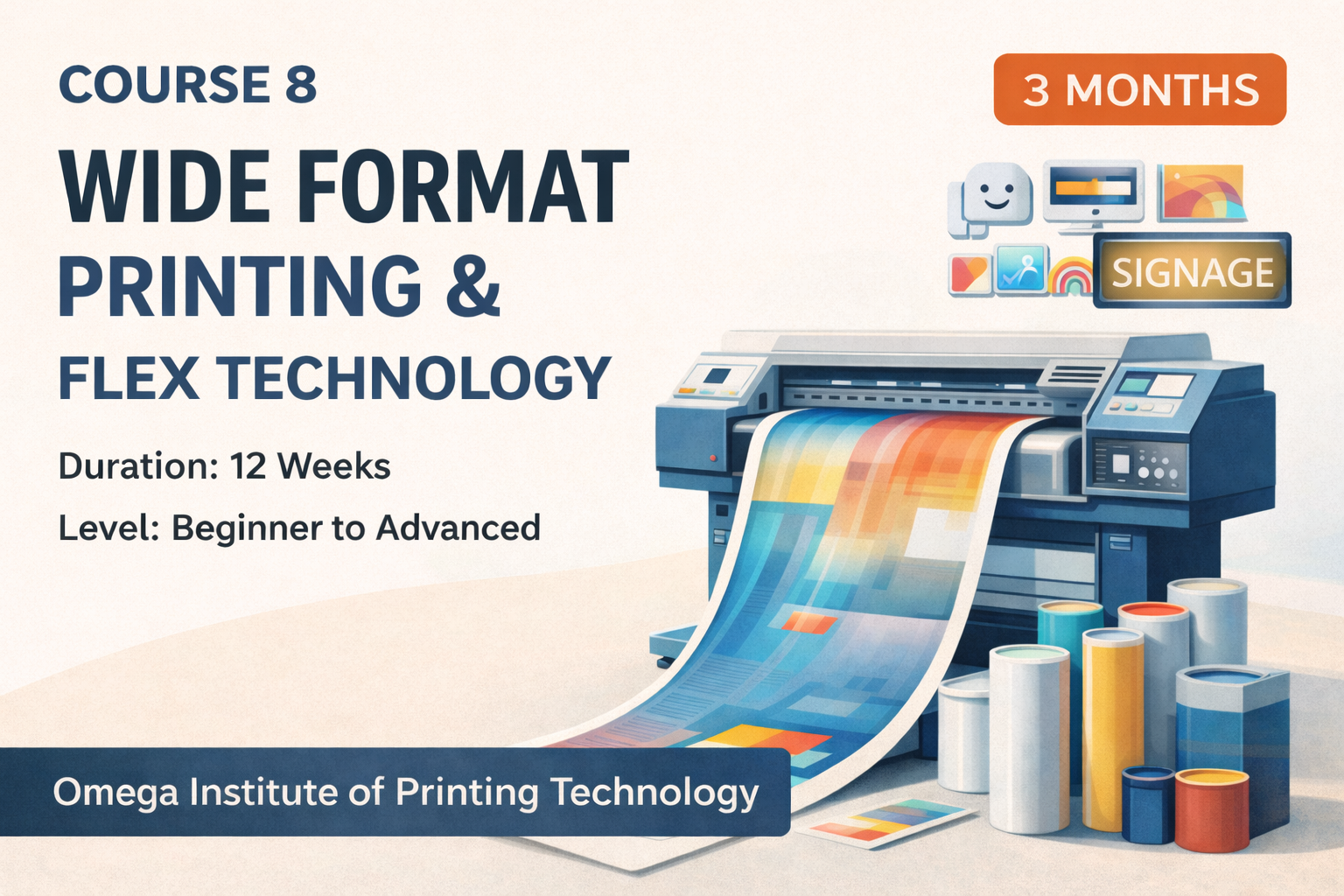
Wide Format Printing & Flex Technology is a hands-on, industry-oriented course designed to train students in large-format printing used for signage, advertising, branding, and visual communication. The course covers solvent and eco-solvent printing, flex and vinyl media handling, RIP software workflow, colour management, machine maintenance, finishing, and installation techniques.
This program is built around real production practices followed in professional signage units. By the end of the course, learners will be able to independently operate wide-format printers, produce commercial-grade prints, troubleshoot common issues, and deliver ready-to-install signage products.
What Will You Learn?
- Understand wide-format printing technologies and applications
- • Operate solvent and eco-solvent flex printers confidently
- • Prepare artwork for large-format printing using correct DPI and colour modes
- • Use RIP software for scaling, tiling, colour control, and job management
- • Print on flex, vinyl, backlit, one-way vision, reflective, and canvas media
- • Control print modes, ink density, heat, and media tension
- • Perform daily, weekly, and monthly machine maintenance
- • Identify and fix banding, colour shift, drying, and feed issues
- • Finish prints using trimming, eyelets, lamination, and mounting
- • Install signage on ACP, sunboard, walls, glass, and lightboxes
- • Produce professional signage ready for real clients
- • Build a portfolio of commercial wide-format print outputs
Course Content
CHAPTER 1: INTRODUCTION TO WIDE FORMAT PRINTING
-
1.0
-
1.1 The Evolution of Wide-Format Printing
-
1.2 What Makes a Printer “Wide-Format”?
-
1.3 Major Types of Wide-Format Printers
-
1.4 Understanding Wide-Format Printheads
-
1.5 Types of Media Used in Wide-Format Printing
-
1.6 Applications of Wide-Format Printing
-
1.7 The Wide-Format Printing Workflow
-
1.8 Importance of Colour Theory in Wide-Format Printing
-
1.9 Environmental & Safety Considerations
-
1.10 Skills Required to Become a Wide-Format Operator
-
1.11 Industry Trends & Future of Wide-Format Printing
-
1.12 Summary of Chapter 1
CHAPTER 2: UNDERSTANDING MEDIA & INKS
-
2.0
-
2.1 Introduction to Media Science in Wide-Format Printing
-
2.2 Flex Media: The Backbone of Indian Outdoor Advertising
-
2.3 Vinyl Media: The Premium Class of Wide-Format Printing
-
2.4 One-Way Vision: The Signature of Glass Branding
-
2.5 Canvas and Photo Media
-
2.6 Ink Technologies in Wide-Format Printing
-
2.7 How Inks Behave on Different Media
-
2.8 Understanding Ink Limits, Density & Pass Modes
-
2.9 Media Storage, Handling & Preservation
-
2.10 Choosing the Right Media for a Job
-
2.11 Common Media-Related Problems & Solutions
-
2.12 Summary of Chapter 2
CHAPTER 3: FILE PREPARATION FOR FLEX & VINYL
-
3.0
-
3.1 Why File Preparation Matters
-
3.2 Key Design Software Used in Wide-Format Printing
-
3.3 Understanding Resolution for Large-Format Prints
-
3.4 Colour Modes: RGB vs CMYK in Wide-Format Printing
-
3.5 Bleed, Safe Zones & Margins
-
3.6 Visibility Principles for Large-Format Design
-
3.7 Understanding File Dimensions & Scale
-
3.8 Essential Export Formats
-
3.9 File Optimisation for Fast RIP Processing
-
3.10 Preparing Files for Specific Media
-
3.11 Understanding Cut-Contour Lines (For Stickers)
-
3.12 Common File Preparation Mistakes
-
3.13 Checklist Before Sending to RIP
-
3.14 Summary of Chapter 3
CHAPTER 4: RIP SOFTWARE & JOB HANDLING
-
4.0
-
4.1 What is RIP Software?
-
4.2 Why RIP Software Is Essential
-
4.3 Understanding the RIP Interface
-
4.4 Importing Jobs
-
4.5 Scaling & Size Adjustments
-
4.6 Tiling Large Prints
-
4.7 Step-and-Repeat
-
4.8 ICC Profiles & Colour Calibration
-
4.9 Rasterisation & Its Importance
-
4.10 Adjusting Ink Limits
-
4.11 Pass Modes & Print Speed
-
4.12 Print Direction: Uni vs Bidirectional
-
4.13 Drying Settings & Heater Control
-
4.14 Cut-Contour & Cutting Plotter Setup
-
4.15 Batch Printing & Job Queues
-
4.16 Troubleshooting RIP Issues
-
4.17 Operator Best Practices
-
4.18 Summary of Chapter 4
CHAPTER 5: COLOUR MANAGEMENT FOR WIDE-FORMAT PRINTING
-
5.0
-
5.1 The Importance of Colour Management in Large-Format Printing
-
5.2 Understanding Colour in Printing: CMYK vs RGB
-
5.3 The Role of ICC Profiles in Wide-Format Printing
-
5.4 Types of ICC Profiles Needed
-
5.5 Colour Calibration & Linearisation
-
5.6 Factors Affecting Colour Output
-
5.7 Managing Key Colours & Brand Identity
-
5.8 Understanding Neutral Colours & Grey Balance
-
5.9 Ink Density, Total Ink Limit & Drying
-
5.10 Understanding Black: C100 vs Rich Black vs True Black
-
5.11 Colour Correction Best Practices
-
5.12 Colour Testing & Sample Printing
-
5.13 Colour Issues & Troubleshooting
-
5.14 Professional Colour Workflow for Omega Operators
-
5.15 Summary of Chapter 5
CHAPTER 6: PRINT MODES & MEDIA HANDLING
-
6.0
-
6.1 Understanding Print Modes
-
6.2 Uni-directional vs Bi-directional Printing
-
6.3 Head Speed & Carriage Movement
-
6.4 Head Height Adjustment
-
6.5 Media Feeding & Tension Control
-
6.6 Media Loading Techniques
-
6.7 Material Behaviour Under Heat
-
6.8 Managing Static Electricity
-
6.9 Feed Calibration & Step Adjustment
-
6.10 Test Printing Before Production
-
6.11 Print Quality vs Speed: Finding the Balance
-
6.12 Common Print Mode & Media Handling Errors
-
6.13 Best Practices for Professional Operators
-
6.14 Summary of Chapter 6
CHAPTER 7: PRINTHEAD & MACHINE MAINTENANCE
-
7.0
-
7.1 Understanding the Role of the Printhead
-
7.2 How Printheads Work
-
7.3 The Ink Delivery System
-
7.4 Types of Printhead Cleaning
-
7.5 Nozzle Checks: The Daily Diagnostic
-
7.6 Nozzle Clogging: Causes & Prevention
-
7.7 Head Strike: The Most Dangerous Event
-
7.8 Capping Station Maintenance
-
7.9 Wiper Blade Maintenance
-
7.10 Pump Maintenance
-
7.11 Environmental Factors That Affect Printheads
-
7.12 Ink Quality & Storage
-
7.13 Cleaning Mistakes Operators Must Avoid
-
7.14 How Often Should Maintenance Be Done?
-
7.15 Diagnosing Printhead Problems
-
7.16 Preventing Long-Term Head Damage
-
7.17 Machine Maintenance Beyond Printheads
-
7.18 Maintaining Stability Across Long Runs
-
7.19 The Operator’s Golden Rules
-
7.20 Summary of Chapter 7
CHAPTER 8: PRINTING ON DIFFERENT SIGNAGE MATERIALS
-
8.0
-
8.1 Overview of Signage Materials
-
8.2 Printing on Front-Lit Flex
-
8.3 Printing on Backlit Flex
-
8.4 Printing on Blackout Media
-
8.5 Printing on Vinyl
-
8.6 Printing on One-Way Vision
-
8.7 Printing on Reflective Vinyl
-
8.8 Printing on Canvas
-
8.9 Printing on PET & Transparent Films
-
8.10 Printing on Textured Special Media
-
8.11 Printing on Fabric (Limited to Sublimation)
-
8.12 Optimizing Print Settings for Each Material
-
8.13 Environmental Effects on Media Printing
-
8.14 Troubleshooting Media-Specific Issues
-
8.15 Best Practices for Printing Across All Media
-
8.16 Summary of Chapter 8
CHAPTER 9: ADVANCED WIDE-FORMAT TECHNIQUES
-
9.0
-
9.1 What Are Advanced Wide-Format Techniques?
-
9.2 High-Resolution Photo Printing
-
9.3 Backlit Colour Enhancement
-
9.4 Double-Layer Printing
-
9.5 Advanced Colour Depth Management
-
9.6 Contour-Cut Sticker Printing
-
9.7 Lamination & Protection
-
9.8 Multi-Panel Seamless Wall Graphics
-
9.9 Exhibition & Event Graphics
-
9.10 Vehicle Wrap Printing
-
9.11 Wall Textures & Interior Décor Printing
-
9.12 Gloss–Matte Hybrid Effects
-
9.13 Printing for Signboards (ACP + Vinyl)
-
9.14 Advanced Troubleshooting Techniques
-
9.15 Best Practices for Advanced Techniques
-
9.16 Summary of Chapter 9
CHAPTER 10: FINISHING & POST-PROCESSING
-
10.0
-
10.1 What is Finishing?
-
10.2 Importance of Finishing in Signage Production
-
10.3 Essential Finishing Tools & Equipment
-
10.4 Trimming & Cutting Techniques
-
10.5 Edge Binding & Tape Reinforcement
-
10.6 Grommeting (Eyelets)
-
10.7 Lamination: Protection & Enhancement
-
10.8 Mounting on Sunboard / Foamboard
-
10.9 Acrylic & ACP Board Finishing
-
10.10 Lightbox Finishing & Assembly
-
10.11 Sticker Finishing & Weeding
-
10.12 Panel Joining for Large Prints
-
10.13 Rolling & Packing
-
10.14 Installation Preparation
-
10.15 Quality Control for Finished Products
-
10.16 Safety in Finishing Department
-
10.17 Common Finishing Problems & Solutions
-
10.18 Best Finishing Practices for Professional Results
-
10.19 Summary of Chapter 10
CHAPTER 11: SIGNAGE INSTALLATION TECHNIQUES
-
11.0
-
11.1 The Importance of Professional Signage Installation
-
11.1 The Importance of Professional Signage Installation
-
11.2 Tools Required for Signage Installation
-
11.3 Understanding Surface Types
-
11.4 Vinyl Installation Techniques
-
11.5 Installation of ACP Signboards
-
11.6 Sunboard / Foamboard Installation
-
11.7 Lightbox Flex Installation
-
11.8 LED Lightbox / Acrylic Sign Installation
-
11.9 Vehicle Branding Installation
-
11.10 Wall Wrap Installation
-
11.11 Glass Branding Installation
-
11.12 Hanging Displays & Pole Banners
-
11.13 Safety in Installation
-
1.14 Quality Testing After Installation
-
11.15 Maintenance After Installation
-
11.16 Common Installation Problems & Solutions
-
11.17 Professional Installation Tips
-
11.18 Summary of Chapter 11
CHAPTER 12: TROUBLESHOOTING IN WIDE-FORMAT PRINTING
-
12.0
-
12.1 The Mindset of a Troubleshooting Expert
-
12.2 Categories of Printing Problems
-
12.3 Diagnosing Problems Systematically
-
12.4 Colour Problems
-
12.5 Banding Issues
-
12.6 Drying & Ink Adhesion Issues
-
12.7 Printhead & Nozzle Problems
-
12.8 Ink Flow Issues
-
12.9 Media Issues
-
12.10 Mechanical Issues
-
12.11 RIP Software Problems
-
12.12 Environmental Issues
-
12.13 Installation-Related Problems
-
12.14 The Troubleshooting Checklist
-
12.15 Preventing Problems Before They Occur
-
12.16 Summary of Chapter 12
CHAPTER 13: ROUTINE MAINTENANCE & SERVICE SCHEDULE
-
13.0
-
13.1 Why Routine Maintenance Is Essential
-
13.2 Categories of Maintenance
-
13.3 Daily Maintenance
-
13.4 Weekly Maintenance
-
13.5 Monthly Maintenance
-
13.6 Quarterly Maintenance
-
13.7 Annual Maintenance
-
13.8 Event-Based Maintenance (When Certain Issues Appear)
-
13.9 Maintenance Checklist
-
13.10 Extending Printhead Life Through Maintenance
-
13.11 Environmental Maintenance
-
13.12 Storage & Consumable Maintenance
-
13.13 Operator’s Role in Maintenance
-
13.14 Summary of Chapter 13
CHAPTER 14: FINAL PROJECTS, PRACTICAL EXAM & PORTFOLIO DEVELOPMENT
-
14.0
-
14.1 Purpose of Final Projects
-
14.2 Structure of Final Assessment
-
14.3 The Six Mandatory Final Projects
-
14.4 Evaluation Criteria for Final Projects
-
14.5 The Practical Examination (70%)
-
14.6 Viva / Oral Examination (30%)
-
14.7 Portfolio Development
-
14.8 Preparing Students for Real-World Jobs
-
14.9 Real-Client Simulation Projects (Optional Advanced Module)
-
14.10 Soft Skills Included in Final Training
-
14.11 Passing Criteria
-
14.12 Instructor Tips for Conducting Final Projects
-
14.13 Summary of Chapter 14
Student Ratings & Reviews

No Review Yet