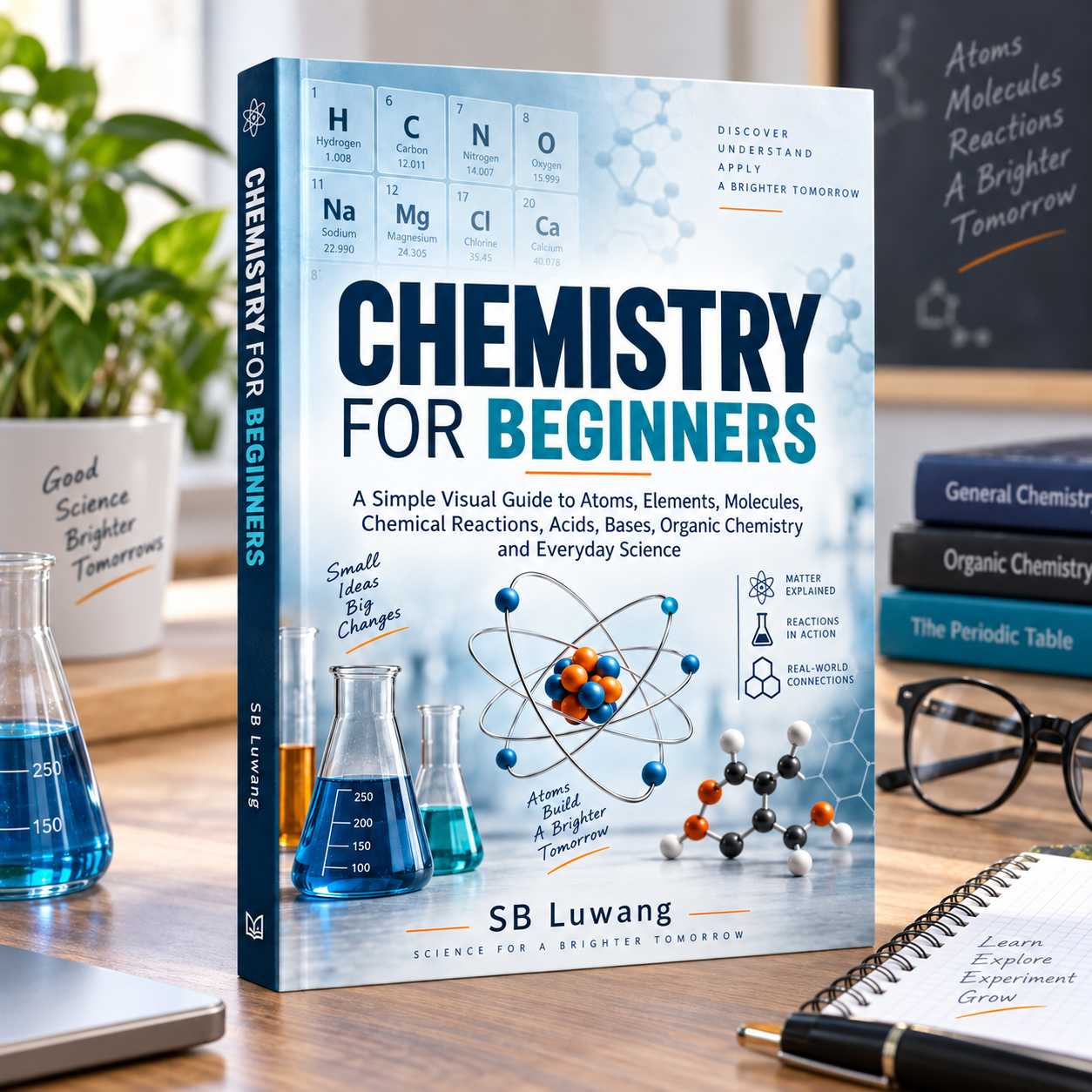
Chemistry Made Clear, Visual and Practical
Chemistry is everywhere—in the food we cook, the water we drink, the medicines we use, the batteries that power our devices, the fuels we burn, and even the reactions taking place inside our bodies.
Yet chemistry can feel difficult when it is introduced only through formulas, equations, and unfamiliar terminology.
Chemistry for Beginners was created to make the subject easier to understand.
Starting with the basic idea of matter, the book gradually builds toward atoms, elements, the periodic table, chemical bonding, reactions, calculations, acids and bases, organic chemistry, electrochemistry, environmental chemistry, and practical laboratory skills.
Instead of asking readers to memorize disconnected facts, the book repeatedly connects three levels of chemistry:
What we observe → What particles are doing → How chemistry represents it with symbols and equations
What You Will Learn
The book covers:
- Matter and states of matter
- Physical and chemical changes
- Atomic structure
- Protons, neutrons and electrons
- Atomic number, mass number and isotopes
- Elements and chemical symbols
- Understanding the periodic table
- Molecules and compounds
- Ions and ionic charge
- Ionic, covalent and metallic bonding
- Valency and writing formulas
- Understanding chemical reactions
- Balancing chemical equations
- Types of chemical reactions
- Oxidation and reduction
- Measurement and scientific notation
- The mole and Avogadro constant
- Molar mass
- Stoichiometry
- Pure substances and mixtures
- Separation techniques
- Solutions and concentration
- Acids
- Bases and alkalis
- The pH scale
- Salts and salt preparation
- Energy in chemical reactions
- Exothermic and endothermic processes
- Reaction rates and catalysts
- Carbon chemistry
- Hydrocarbons
- Functional groups
- Polymers
- Water chemistry
- Chemistry of food
- Chemistry of the human body
- Kitchen chemistry
- Soap and detergents
- Metals and corrosion
- Fuels and combustion
- Batteries and electrochemistry
- Environmental chemistry
- Laboratory safety
- Common laboratory equipment
- Experimental design
- Safe beginner experiments
- Reading chemical equations
- Common chemistry mistakes
- Chemistry problem-solving strategies
Designed for Beginners
Each chapter uses a consistent learning structure that includes:
- Clear learning objectives
- Simple explanations
- Visual concept maps
- Chemical equations
- Worked examples
- Everyday chemistry applications
- Chemistry Check questions
- Common Mistake boxes
- Key terms
- Chapter summaries
- Level A — Recall exercises
- Level B — Application exercises
- Level C — Think Like a Chemist challenges
Strong Visual Learning Approach
The book includes numerous diagrams and visual explanations covering concepts such as:
- atomic structure;
- periodic-table organization;
- bonding;
- chemical reactions;
- reaction-energy pathways;
- stoichiometry;
- mixtures and solutions;
- polymers;
- electrochemical cells;
- environmental chemistry.
These visual tools help readers connect abstract chemistry concepts with understandable models.
Useful Reference Section
The back of the book includes:
- Periodic table guide
- Common elements and symbols
- Common ions
- Common chemical compounds
- Beginner solubility rules
- Common acids and bases
- Chemistry formula sheet
- Laboratory safety reference
- SI units and conversions
- Selected exercise answers
- Chemistry glossary
- Index
Who Is This Book For?
Chemistry for Beginners is suitable for:
- Secondary and higher-secondary students
- College students needing a chemistry refresher
- Competitive-exam beginners
- Homeschool learners
- Teachers looking for supplementary material
- Adult self-learners
- Parents helping children with science
- Anyone curious about how matter and chemical reactions work
Learn Chemistry as a Connected System
The central idea of this book is simple:
The properties and changes we observe in matter arise from the arrangement, motion and interactions of particles.
Once this idea becomes clear, atoms, bonding, equations, reactions, energy and calculations begin to fit together.
Start with the basics. Build understanding step by step. Learn to think like a chemist.



Reviews
There are no reviews yet.