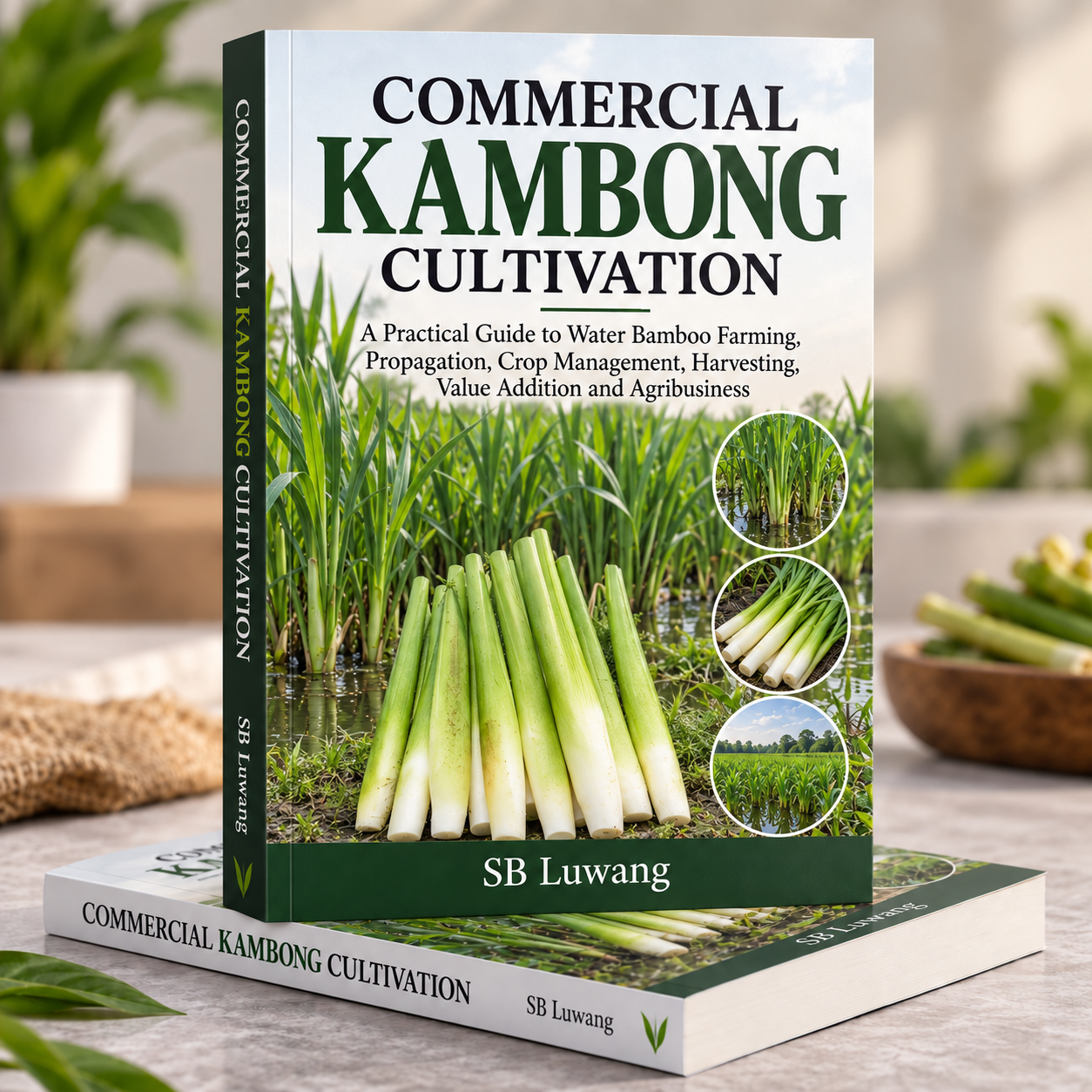
Commercial Kambong Cultivation is a comprehensive practical handbook for anyone interested in developing Kambong into a scientifically managed and commercially profitable agricultural crop.
Kambong, scientifically known as Zizania latifolia, is a perennial wetland grass traditionally known and consumed in Manipur. Its edible swollen stem develops through a unique biological association with the fungus Ustilago esculenta, making Kambong one of the most fascinating specialty vegetable crops in Asia.
Drawing on Manipur ethnobotanical knowledge, modern scientific research, and established Jiaobai cultivation practices from East Asia, author SB Luwang explains how Kambong can be transformed from a traditionally collected wetland food into a structured commercial farming enterprise.
The book covers the complete production cycle—from selecting elite mother plants and preparing nursery stock to designing commercial fields, managing shallow-water cultivation, maintaining plant nutrition, recognizing gall maturity, harvesting at the correct stage, and protecting quality through post-harvest cooling.
Readers will also learn how to evaluate marketable yield, calculate production costs, determine break-even prices, develop grading standards, explore value-added products, and build a distinctive Manipur Kambong brand.
Key Topics Covered
- Botany and identification of Zizania latifolia
- The Zizania latifolia–Ustilago esculenta relationship
- Traditional Kambong use in Manipur
- Jiaobai cultivation lessons from East Asia
- Germplasm collection and elite mother-stock selection
- Rhizome propagation and nursery management
- Commercial field layout and land preparation
- Plant spacing and population management
- Stage-wise water management
- Soil fertility and plant nutrition
- Tiller and canopy management
- Gall initiation and maturity
- Weed, pest, and disease management
- Harvesting and commercial grading
- Post-harvest handling and cold chain
- Processing and value-added Kambong products
- Farm economics and break-even analysis
- Marketing, branding, and agribusiness planning
- Practical field registers and worksheets
- One-acre and one-hectare planning tools
- Research priorities for Manipur
The book carefully distinguishes between scientifically verified findings, commercial East Asian practices, documented Manipur knowledge, and recommendations that still require local field validation.
This makes it useful not only as a farming guide but also as a reference for agricultural researchers, entrepreneurs, extension workers, farmer groups, and policy planners.
Ideal For
Farmers and progressive growers, agripreneurs, agriculture and horticulture students, wetland farmers, FPOs and cooperatives, food-processing entrepreneurs, researchers, extension officers, restaurants and specialty-food businesses, and anyone interested in commercializing traditional crops of Manipur and Northeast India.



Reviews
There are no reviews yet.