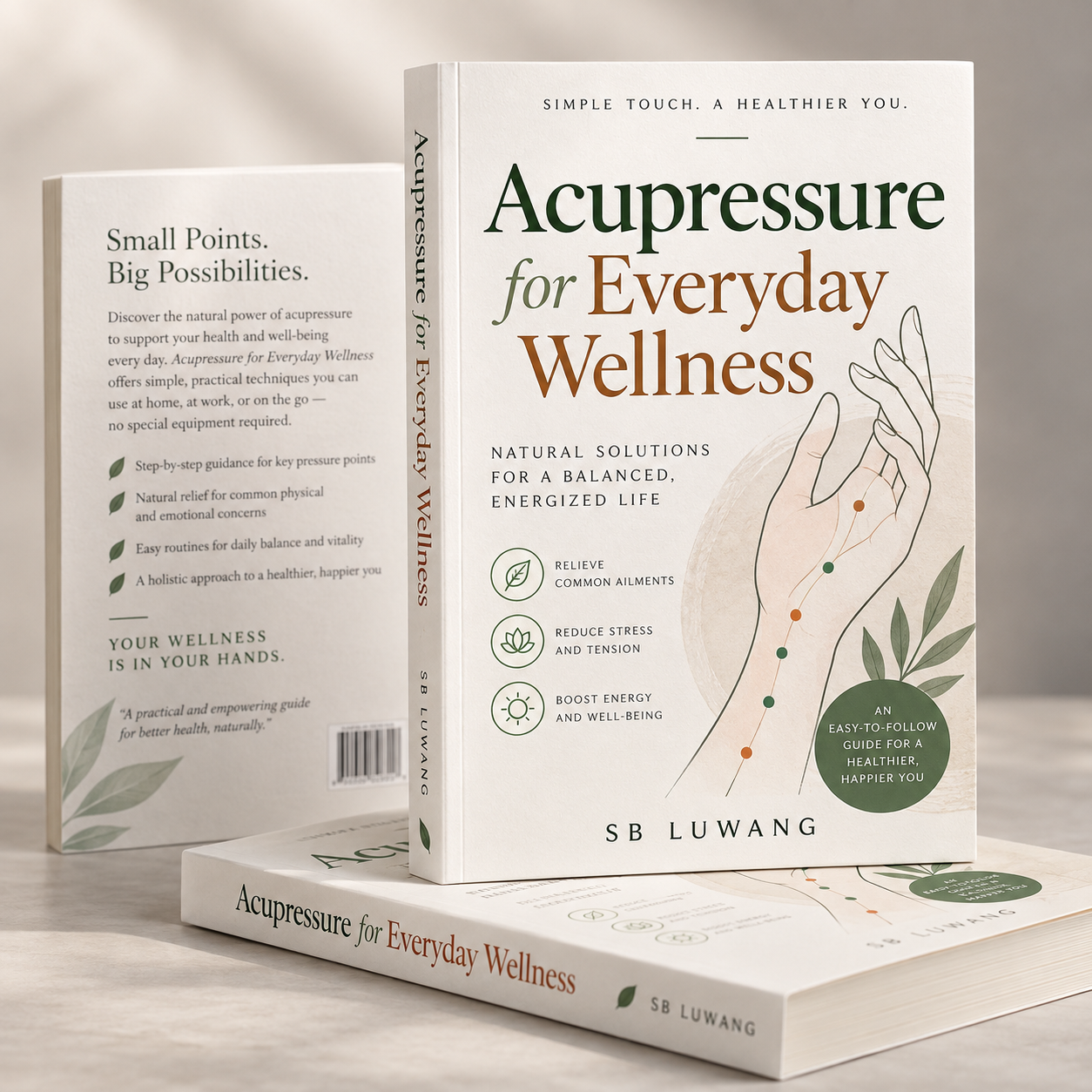
Acupressure Made Practical, Safe, and Easy to Understand
Can simple pressure applied with your fingers support relaxation, nausea management, sleep, muscular comfort, and everyday wellbeing?
Acupressure for Everyday Wellness introduces readers to the traditional practice of acupressure through a modern, evidence-aware approach.
Rather than presenting pressure points as “magic buttons” or promising miracle cures, author SB Luwang explains how acupressure can be used responsibly as a complementary self-care technique.
You’ll learn not only where to press, but also how hard to press, how long to hold each point, when to stop, and when professional medical care is more appropriate.
Learn the Essential Pressure Points
The book includes a practical atlas covering commonly used points such as:
- PC6 — Neiguan
- LI4 — Hegu
- ST36 — Zusanli
- SP6 — Sanyinjiao
- HT7 — Shenmen
- LR3 — Taichong
- Yintang
- GV20 — Baihui
- GB20 — Fengchi
- LI11 — Quchi
- LU7 — Lieque
- TE5 — Waiguan
- GB34 — Yanglingquan
- BL40 — Weizhong
- KI3 — Taixi
- ST25 — Tianshu
- and additional useful points
Each major point includes practical location guidance, traditional associations, pressure technique, evidence notes, safety cautions, and suggested uses.
Practical Routines for Everyday Life
Follow simple step-by-step routines for:
- Nausea and motion sickness
- Headache and head tension
- Neck and shoulder tension
- Lower-back discomfort
- Menstrual discomfort
- Stress and relaxation
- Sleep and evening wind-down
- Fatigue and low-energy days
- Digestive comfort
- Desk-work tension
- Long journeys and travel
The book also includes dedicated five-minute, ten-minute, and twenty-minute routines that make acupressure easy to fit into a busy day.
A Complete 30-Day Beginner Program
If you’re completely new to acupressure, the included 30-Day Beginner Acupressure Program guides you progressively through:
- pressure control;
- point location;
- basic techniques;
- short routines;
- symptom-specific applications;
- creating your own personal practice.
Instead of overwhelming readers with hundreds of points, the program focuses on learning a manageable set of useful techniques well.
Traditional Wisdom Meets Modern Evidence
This book clearly distinguishes between:
Traditional Use — how the point has historically been understood.
Modern Research — what clinical studies currently suggest.
Evidence Limitations — where research remains uncertain.
A simple evidence-rating system helps readers understand which applications are relatively better studied and which remain preliminary or primarily traditional.
Safety Comes First
Special sections explain when acupressure should be avoided or modified, including considerations involving:
- pregnancy;
- recent surgery;
- wounds and infection;
- blood clots;
- neuropathy;
- osteoporosis;
- medical lines and devices;
- cancer treatment;
- older adults;
- severe or unexplained symptoms.
The book also contains a quick-reference Emergency Red-Flag Guide explaining when self-care should stop and medical attention should take priority.
Bonus Reference Material
The appendices include:
- Quick-reference body map
- Pressure points A–Z
- Symptoms-to-points index
- Points-to-symptoms index
- Pregnancy caution chart
- Ready-to-use short routines
- Evidence summary tables
- Acupressure journal pages
- Glossary
- References and further reading
- Quick decision guide
- Emergency red-flag reference
- Reader practice checklists
Who Is This Book For?
Ideal for:
- complete beginners;
- wellness enthusiasts;
- massage and bodywork learners;
- yoga and meditation practitioners;
- caregivers;
- people interested in Traditional Chinese Medicine;
- readers looking for simple non-invasive self-care techniques.
No previous knowledge of acupuncture or acupressure is required.


Reviews
There are no reviews yet.