Enter the World of Modern Fighter Aviation
What allows a fighter jet to fly beyond the speed of sound?
How does a pilot control an aircraft while experiencing several times the force of gravity?
How do radar, fly-by-wire computers, helmet-mounted displays, stealth technology, and artificial intelligence work together inside a modern fighter?
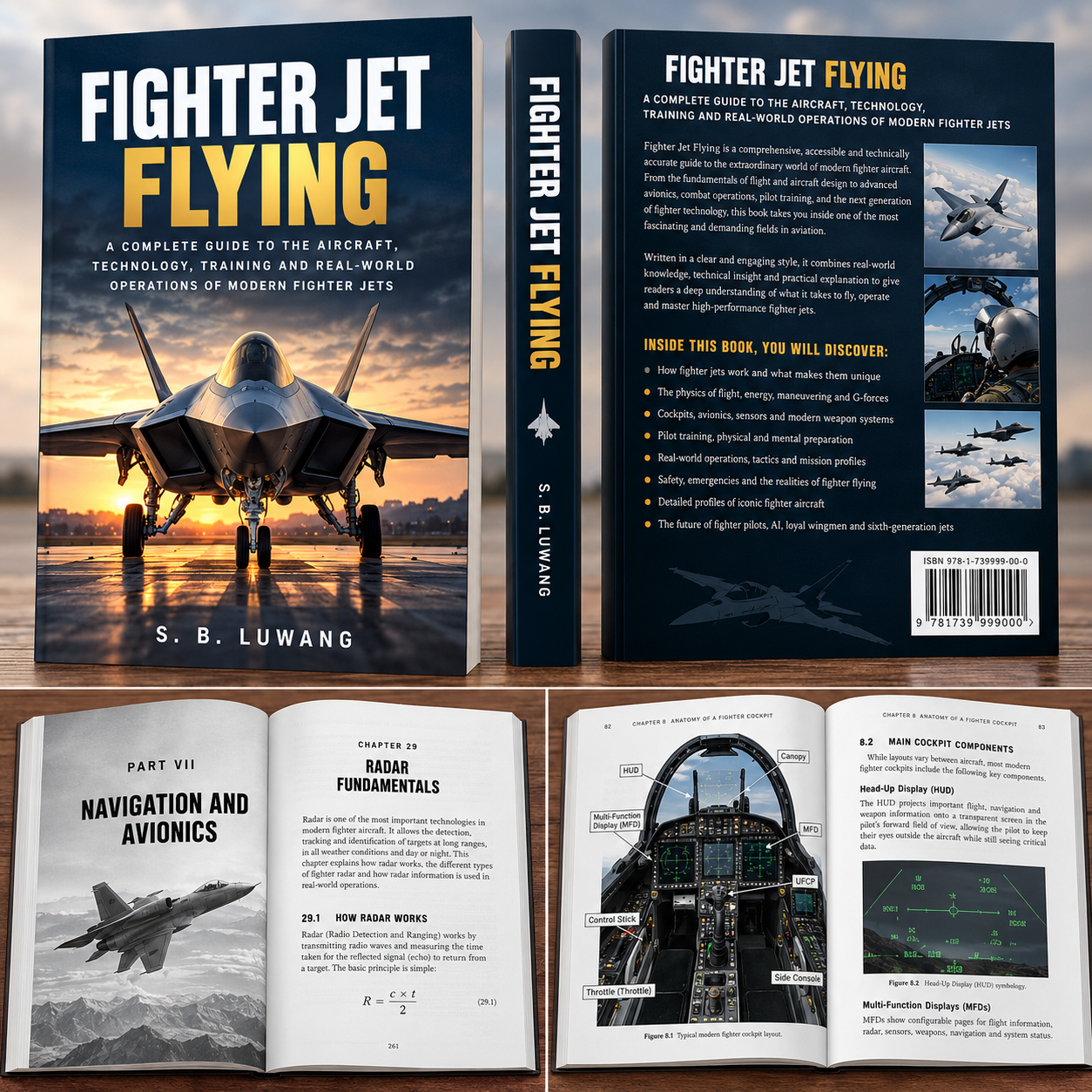
Fighter Jet Flying by SB Luwang takes readers deep into the fascinating science and technology behind high-performance military aviation.
Written in clear, accessible language, this comprehensive guide explains fighter aircraft from the fundamentals of flight to the emerging technologies shaping the next generation of aviation.
Inside the Book
Readers will explore:
- Fundamentals of fighter aircraft and high-performance flight
- Lift, drag, thrust, weight, and angle of attack
- Delta wings, swept wings, canards, LERX, and advanced aerodynamic design
- Turbojet and turbofan engines
- Afterburners and supersonic flight
- Mach number, shock waves, and sonic booms
- Energy management in high-performance aircraft
- Modern fighter cockpit architecture
- HOTAS controls and Head-Up Displays
- Glass cockpits and helmet-mounted displays
- Fly-by-wire flight-control systems
- Takeoff, climb, turning, and landing principles
- G-forces and fighter-pilot physiology
- High-angle-of-attack flight
- Stalls, departures, spins, and loss-of-control concepts
- Fighter-pilot training and physical conditioning
- Aviation psychology and decision-making
- Navigation and inertial-navigation systems
- Radar fundamentals and AESA technology
- Infrared and electro-optical sensors
- Sensor fusion and data links
- Formation flying
- Flight safety and emergency concepts
- Spatial disorientation
- Ejection-seat technology
- Carrier aviation
- Night and adverse-weather flying
- Fighter-jet simulators
- Building a home flight-simulation cockpit
- Stealth and low-observable technology
- Supercruise
- Thrust vectoring
- Artificial intelligence in fighter aviation
- Collaborative uncrewed aircraft and Loyal Wingman concepts
- Sixth-generation fighter technology
- The future role of fighter pilots
Famous Fighter Aircraft Profiles
Dedicated chapters examine the design philosophy and historical importance of:
MiG-21
F-16 Fighting Falcon
Mirage 2000
Su-30 Family
Dassault Rafale
Eurofighter Typhoon
Saab Gripen
HAL Tejas
F-22 Raptor
F-35 Lightning II
Who Is This Book For?
This book is ideal for:
- Aviation enthusiasts
- Students interested in aerospace and aeronautics
- Defence and competitive-exam readers
- Flight-simulation enthusiasts
- Aspiring pilots
- Aircraft modelers
- Technology enthusiasts
- Readers interested in military aviation history
- Anyone curious about how modern fighter jets work
More Than a Book About Speed
Modern fighter aviation is not simply about powerful engines and extreme speed.
It is the integration of aerodynamics, propulsion, structures, computers, sensors, human physiology, psychology, and pilot judgment.
Fighter Jet Flying explains how these elements work together to create some of the most sophisticated aircraft ever built.
With 62 chapters, technical explanations, aircraft comparisons, formulas, glossary material, and reference appendices, this book provides a structured introduction to one of aviation’s most fascinating fields.




Reviews
There are no reviews yet.