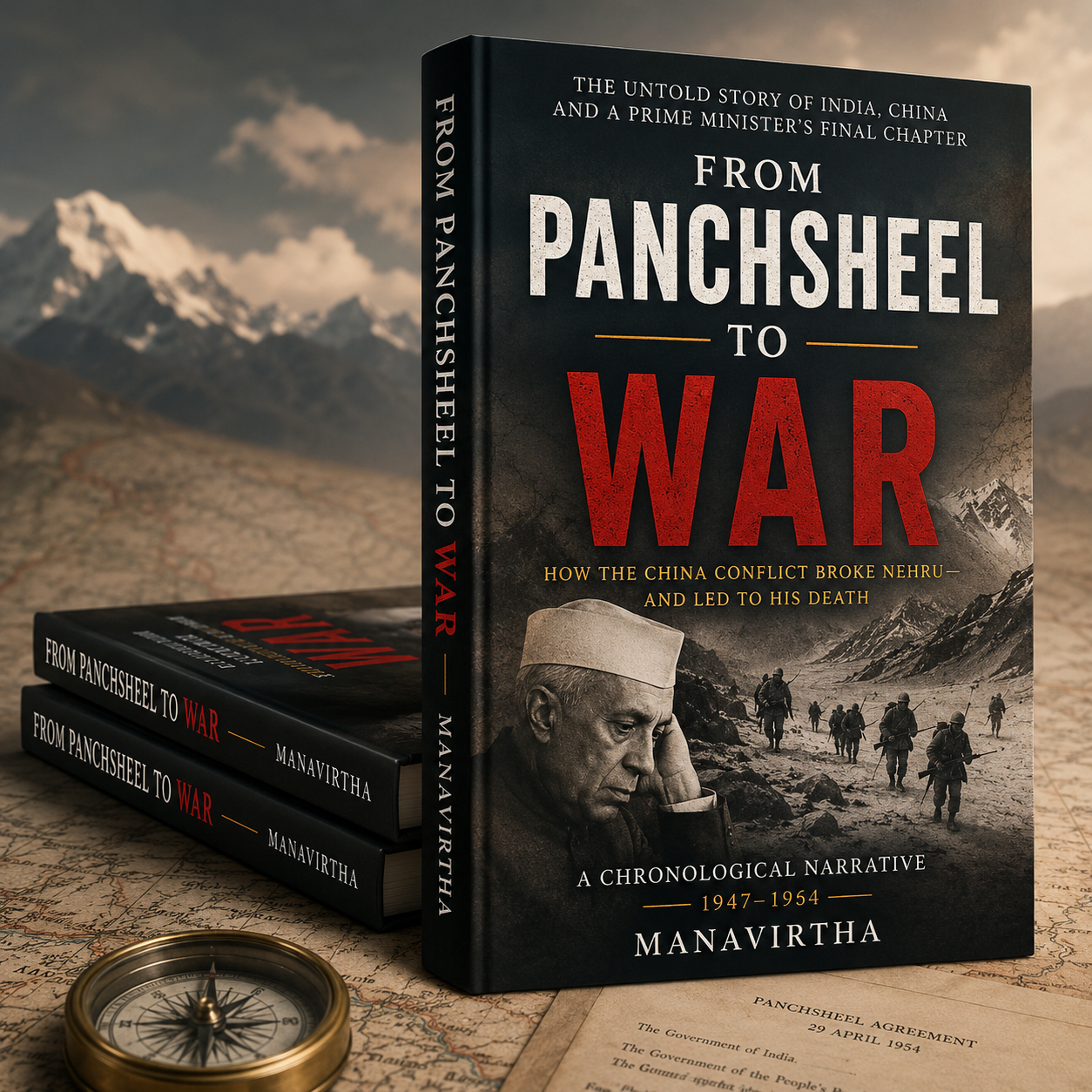
From Asian Friendship to Himalayan War
In 1954, India and China publicly embraced the Five Principles of Peaceful Coexistence—Panchsheel. Jawaharlal Nehru and Zhou Enlai appeared to represent a new era of Asian cooperation.
Eight years later, Indian and Chinese soldiers were fighting a brutal war across the Himalayas.
From Panchsheel to War investigates how that extraordinary transformation occurred.
Beginning with the colonial origins of the Himalayan frontier, the book traces the changing relationship between India, Tibet and China after Indian independence and the establishment of the People’s Republic of China. It examines the 1954 Panchsheel agreement, the optimism surrounding Hindi-Chini Bhai-Bhai, China’s consolidation of Tibet, the construction of the Aksai Chin road and the emergence of increasingly incompatible territorial claims.
The narrative then follows the crisis through the 1959 Tibetan uprising, the Dalai Lama’s flight to India, Longju and Kongka Pass, the Nehru–Zhou correspondence, the unsuccessful negotiations of 1960 and India’s controversial Forward Policy.
The centre of the book provides a detailed account of the 1962 Sino-Indian War, including:
- Aksai Chin and the disputed Himalayan frontier
- The McMahon Line and NEFA
- Dhola Post and Thag La
- The Namka Chu disaster
- The fall of Tawang
- Ladakh and Chushul
- The heroic defence of Rezang La
- Se La and Bomdila
- India’s command and logistical failures
- The controversy over the non-use of offensive air power
- Nehru’s emergency appeal to the United States
- China’s unilateral ceasefire
The book then turns to the political consequences of defeat: the fall of V.K. Krishna Menon, criticism in Parliament, questions of civil-military responsibility, the still-controversial Henderson Brooks–Bhagat review and the rapid rebuilding of India’s armed forces.
Finally, it examines one of the most persistent stories surrounding Jawaharlal Nehru—the claim that the Chinese conflict emotionally destroyed him and ultimately caused his death.
Using documentary evidence from Nehru’s final months, the book separates historical fact from political memory, showing both the immense impact of 1962 on Nehru and the limits of claims that directly connect the military defeat to his death on 27 May 1964.
A Source-Driven History
Rather than reducing 1962 to a story of a single betrayal or a single political failure, From Panchsheel to War examines competing Indian and Chinese claims alongside diplomatic, political and military evidence.
It draws upon:
- Government of India records
- India–China White Papers
- Parliamentary proceedings
- Nehru’s speeches and correspondence
- The 1960–61 Officials’ Report
- Military histories
- American diplomatic and intelligence records
- Chinese documentary scholarship
- Academic research and historical studies
The result is a balanced account of one of the defining crises of modern Indian history.
Ideal For
Readers interested in Jawaharlal Nehru, modern Indian history, India–China relations, Tibet, the 1962 Sino-Indian War, Aksai Chin, the McMahon Line, military history, international relations and Cold War Asia.
From Panchsheel to War is ultimately the story of an extraordinary political transformation: how an ambitious vision of peaceful Asian coexistence collided with unresolved borders, strategic rivalry and war—and how the consequences followed Nehru through the final years of his life.




Reviews
There are no reviews yet.