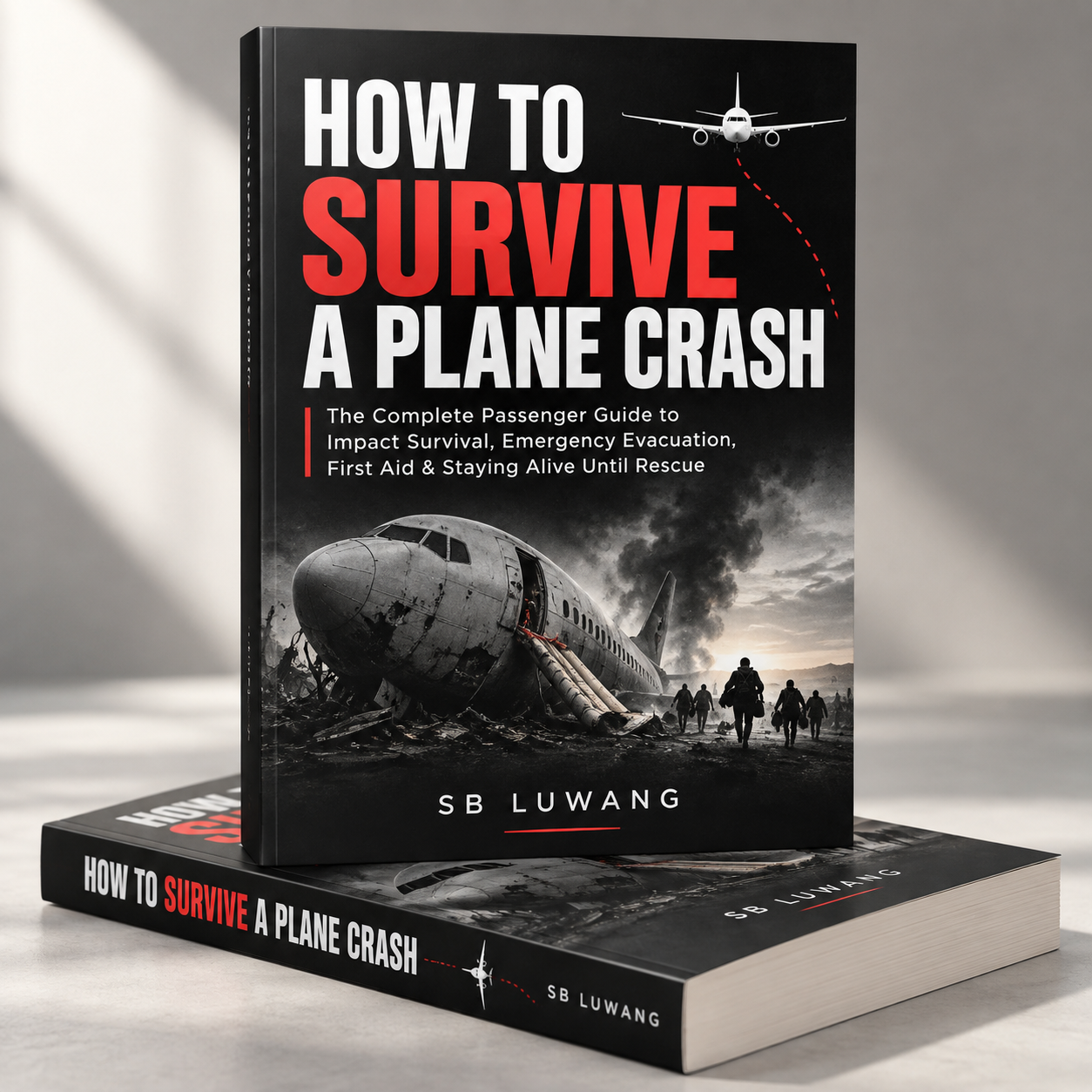
HOW TO SURVIVE A PLANE CRASH
The Complete Passenger Guide to Impact Survival, Emergency Evacuation, First Aid & Staying Alive Until Rescue
By SB Luwang
Most passengers will never experience a serious aviation emergency—but knowing what to do can make a critical difference when seconds matter.
How to Survive a Plane Crash is a comprehensive yet easy-to-follow passenger survival handbook designed for ordinary travellers rather than aviation professionals.
The book begins before the aircraft even leaves the ground.
Readers learn how to perform a simple pre-flight safety check, identify nearby exits, understand their restraint system, read the aircraft safety card effectively and prepare themselves mentally without becoming anxious about flying.
The book then explains what passengers should know during an emergency, including brace preparation, impact survival, cabin evacuation, smoke and fire, emergency exits, slides and water ditching.
The guidance does not pretend that every aviation accident is survivable or that one technique works for every aircraft. Instead, it repeatedly emphasises the importance of following the specific aircraft safety card, cabin-crew commands and emergency personnel instructions.
From Impact to Rescue
Surviving the initial impact may only be the first stage of an emergency.
The book therefore follows the complete survival sequence:
PREPARE → RESTRAIN → PROTECT → EVACUATE → SURVIVE → RESCUE
Readers learn how to respond if evacuation is ordered, why carry-on baggage must be left behind, how to recognise a safe exit, what to do in a smoke-filled cabin and why a life vest should normally not be inflated while still inside the aircraft.
First Aid & Post-Crash Survival
If professional rescue is delayed, the book moves beyond the aircraft.
Topics include:
- Life-threatening bleeding
- Basic CPR and emergency priorities
- Burns and smoke exposure
- Shock and major trauma
- Children and older passengers
- Passengers with disabilities
- Helping others safely
- Hypothermia and extreme heat
- Mountain survival
- Desert survival
- Jungle and tropical survival
- Water and shelter
- Emergency signalling
- Staying near the crash site
- Preparing for rescue
Real Accident Lessons
The book also examines lessons from documented aviation accidents, including major evacuations and water landings, to show how passenger behaviour, luggage, usable exits, crew instructions and post-impact hazards can affect survival.
Rather than sensationalising accidents, these examples are used to identify repeatable safety principles.
Myths vs. Reality
The book addresses common misconceptions such as:
- “Nobody survives plane crashes.”
- “There is one safest seat.”
- “The brace position is designed to kill passengers.”
- “Always use the nearest door.”
- “You should take your passport and phone.”
- “Always crawl through smoke.”
- “Always stay beside the aircraft.”
- “Food should be your first wilderness-survival priority.”
Each myth is replaced with a clearer, safer rule.
Quick Reference Tools
The book includes practical memory systems such as:
EXIT — ROWS — BELT — CARD — SHOES — PLAN
for pre-flight preparation,
and:
BELT — DANGER — CREW — EXIT — MOVE — CLEAR
for evacuation.
It also includes:
- One-Minute Passenger Emergency Card
- Family Flight Emergency Plan
- Personal Flight Safety Worksheet
- Aviation survival glossary
- Source and verification notes
- Training recommendations
Who Is This Book For?
Ideal for:
Air travellers • Frequent flyers • International travellers • Families • Students • Tourists • Adventure travellers • Aviation enthusiasts • Emergency-preparedness readers • People who want to feel more prepared when flying
The purpose of this book is not to make flying frightening.
It is to replace uncertainty with simple, practical knowledge.
Remember:
Wear the belt. Know the exits. Follow the crew. Brace correctly. Leave your bags. Get clear of danger. Solve the next life-threatening problem first.



Reviews
There are no reviews yet.