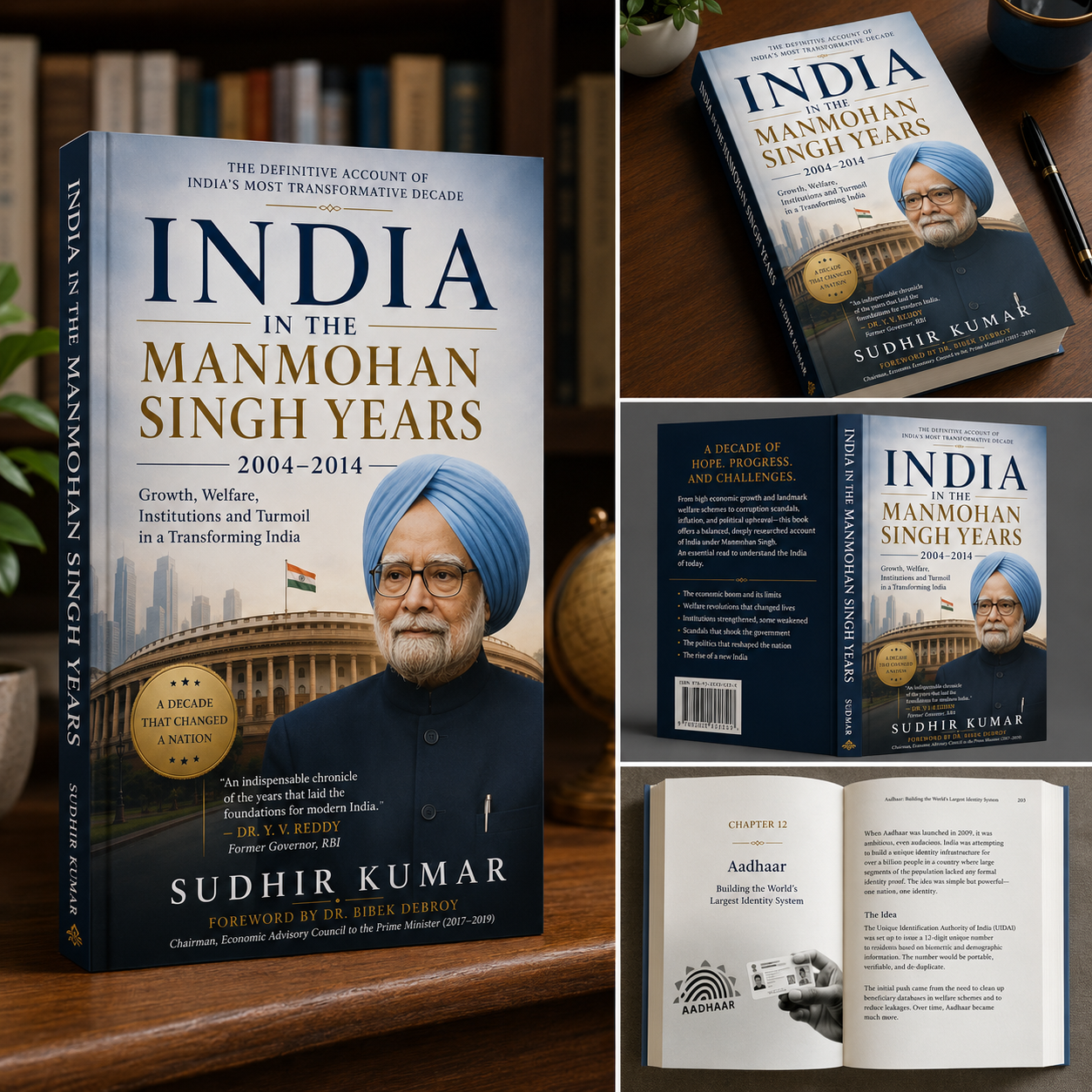
A Decade That Changed India
Between 2004 and 2014, India underwent one of the most consequential transformations in its post-independence history.
At the centre of this extraordinary decade stood Dr. Manmohan Singh—economist, reformer and India’s Prime Minister for ten continuous years.
India in the Manmohan Singh Years provides a comprehensive and balanced account of the political, economic and social forces that defined the UPA era.
The book follows India’s journey from the optimism of the mid-2000s economic boom through the global financial crisis, the expansion of the welfare state, major diplomatic breakthroughs and finally the corruption controversies, inflation, mass protests and political upheaval that culminated in the historic 2014 general election.
Inside the Book
Explore major developments including:
- The formation and politics of UPA I and UPA II
- India’s extraordinary mid-2000s economic boom
- The National Rural Employment Guarantee Act (MGNREGA)
- The revolutionary Right to Information Act
- Expansion of rural health, education and welfare
- The India–US Civil Nuclear Agreement
- India’s changing relationships with the United States, China and Pakistan
- The 26/11 Mumbai terrorist attacks
- India’s response to the 2008 global financial crisis
- The telecommunications revolution
- The creation and expansion of Aadhaar
- The Commonwealth Games
- The 2G spectrum and coal-allocation controversies
- Anna Hazare and the anti-corruption movement
- The Nirbhaya protests and criminal-law reforms
- Creation of Telangana
- The rise of India’s new middle class
- Bollywood, cricket, the IPL and changing popular culture
- Facebook, Twitter and the beginnings of digital politics
- Transformation of rural India
- Inflation, stalled investment and the economic slowdown
- The origins of India’s later banking and NPA crisis
- The rise of Narendra Modi
- Rahul Gandhi and the Congress succession problem
- The revolutionary 2014 election campaign
- The fall of the UPA and emergence of a new political era
Beyond Politics
This is not simply a history of governments and elections.
The book examines how ordinary India changed.
Mobile phones connected hundreds of millions of people. Low-cost airlines transformed travel. Shopping malls and private education reflected a growing middle class. Migration connected villages with expanding cities. Television became increasingly powerful, while Orkut, Facebook and Twitter introduced Indians to an entirely new political information environment.
By 2014, India was richer, more connected, more rights-conscious, more globally ambitious—and considerably more impatient with ineffective government.
A Balanced Assessment of Manmohan Singh
Was Manmohan Singh the architect of one of India’s greatest periods of economic expansion?
Was he a constrained prime minister unable to control coalition partners and corruption controversies?
Did his government construct the foundations of India’s modern welfare and digital state?
Or did UPA II squander the extraordinary political and economic opportunities created during his first term?
Rather than reducing the decade to partisan slogans, this book examines the evidence across separate economic, welfare, democratic and institutional ledgers.
The result is a nuanced portrait of a prime minister whose reputation remains inseparable from the transformation of twenty-first-century India.




Reviews
There are no reviews yet.