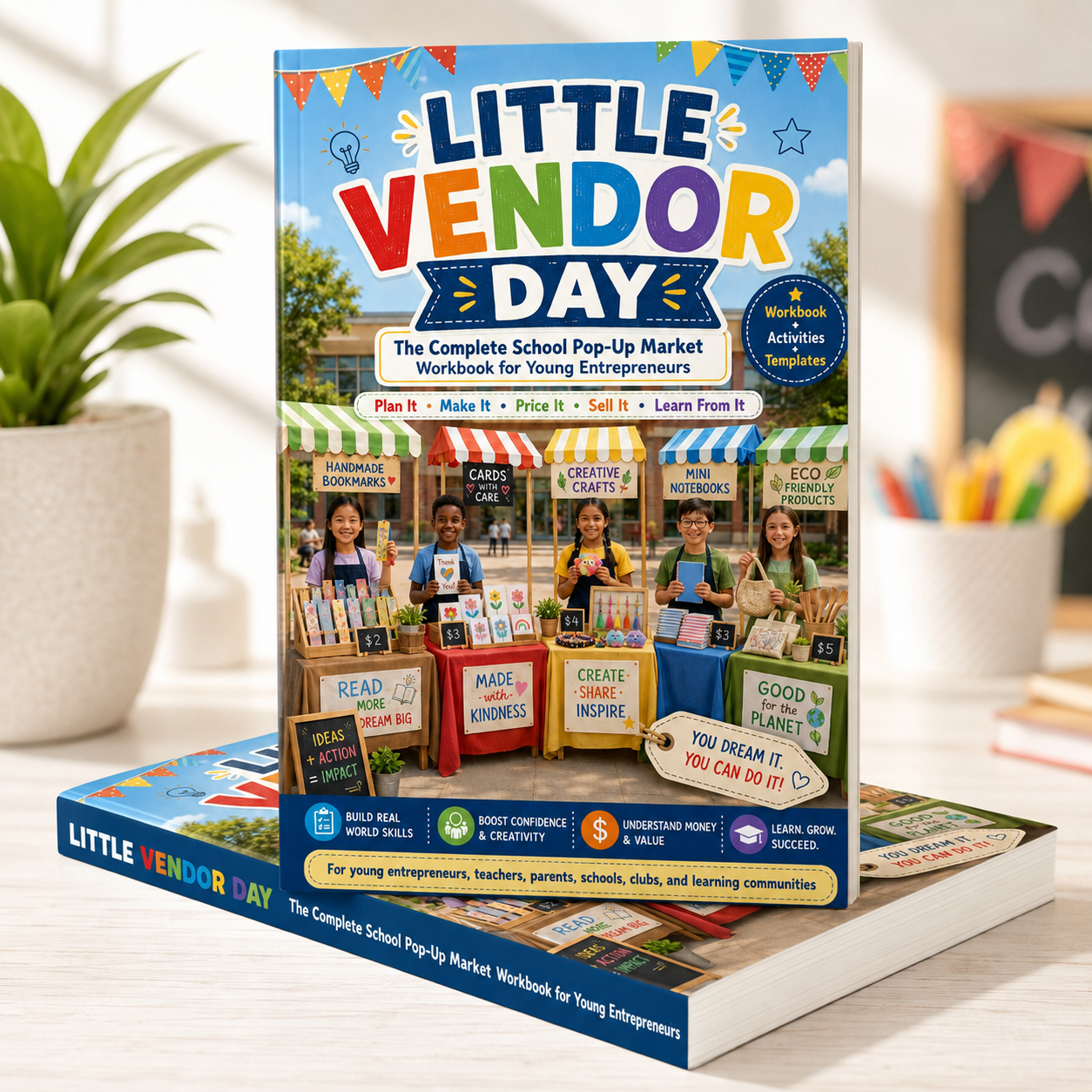
LITTLE VENDOR DAY
The Complete School Pop-Up Market Workbook for Young Entrepreneurs
What if children could learn mathematics, communication, creativity, money management, teamwork, marketing and problem-solving by actually running a small business?
Little Vendor Day turns the traditional school market or vendor event into a complete hands-on entrepreneurship programme.
Designed for young learners, teachers, parents and schools, this extensive workbook guides children step by step from the first business idea to the final Market Day reflection.
Children learn that entrepreneurship is not simply about making money. It is about creating value, solving problems, making responsible decisions, communicating with customers and learning from real results.
The book uses the easy-to-follow:
I.D.E.A. → P.O.P. Method
Investigate → Design → Estimate → Advertise → Pop Up → Observe → Profit & Ponder
Young entrepreneurs work through realistic activities covering business ideas, customer research, prototypes, product quality, production planning, startup budgets, unit costs, pricing, break-even, profit and loss, branding, stall design, ethical marketing, selling skills, giving change, stock management, customer feedback and reinvestment.
Inside the Book
- Business idea-generation activities
- Customer research worksheets
- Product prototype and testing exercises
- Startup-budget planning
- Cost-per-item calculations
- Pricing and profit activities
- Break-even exercises
- Revenue and expense tracking
- Cash and token-market systems
- Branding and business-name activities
- Logo and stall-planning worksheets
- Merchandising and display lessons
- Customer-service scripts
- Giving-change practice
- Sales and inventory records
- Ethical advertising lessons
- Eco-friendly business challenges
- Team-business activities
- Social-enterprise projects
- Realistic Market Day simulations
- Business case studies
- Entrepreneurship challenges
- Age-specific learning tracks
- Teacher lesson plans
- School-event planning guidance
- Safety and inclusion guidance
- Parent participation rules
- Assessment rubrics
- Vendor application forms
- Product-approval forms
- Risk-review sheets
- Customer-feedback forms
- Market Day checklists
- Certificates
- Reproducible classroom tools
- 100 business idea starters
- Student journals
- Capstone business-planning activities
- Answer keys and glossary
Suitable for Different Ages
The workbook includes differentiated pathways for:
Little Sellers – Ages 5–7
Confidence, counting, choices and simple selling.
Junior Vendors – Ages 7–9
Simple pricing, sales records and giving change.
Young Entrepreneurs – Ages 10–12
Research, budgeting, branding and profit.
Pop-Up Founders – Ages 13–16
Margins, forecasting, teamwork, cash flow and reinvestment.
Teachers can adapt activities according to each child’s ability and learning needs.
More Than a Fundraiser
A Little Vendor event can combine:
Mathematics — costing, multiplication, percentages and change
Language — pitches, descriptions and communication
Art & Design — branding, packaging and displays
Economics — supply, demand, scarcity and competition
Financial Literacy — revenue, cost, profit, saving and reinvestment
Social Skills — teamwork, confidence and customer service
Environmental Learning — reuse, low-waste design and responsible claims
Entrepreneurship — turning an idea into something another person values
Designed for Schools
The book also provides teachers and organisers with practical resources for running an entire school pop-up event, including vendor applications, parent commitments, product approvals, safety reviews, stall allocations, sales records, judging rubrics, token systems and post-event evaluation.
A central principle runs throughout the book:
HELP THE CHILD — DON’T BECOME THE BUSINESS.
Adults provide supervision, permission, transport and appropriate assistance while children retain meaningful ownership of their ideas, products, pricing and customer interactions.
Perfect For
Schools, entrepreneurship clubs, financial-literacy programmes, classroom Market Days, business fairs, homeschool projects, summer camps, youth clubs, school exhibitions, project-based learning, after-school programmes and community learning events.
The Real Lesson
Children do not need to sell everything.
They do not need the most beautiful stall.
They do not need to make the biggest profit.
A pricing mistake can teach them.
Unsold stock can teach them.
A difficult customer question can teach them.
Selling out can teach them.
A loss can teach them.
The most valuable thing produced during Little Vendor Day is not necessarily what is sitting on the table.
It is the confidence, judgement, creativity and experience the child takes home.
Little Vendor Day — Plan It • Make It • Price It • Sell It • Learn From It




Reviews
There are no reviews yet.