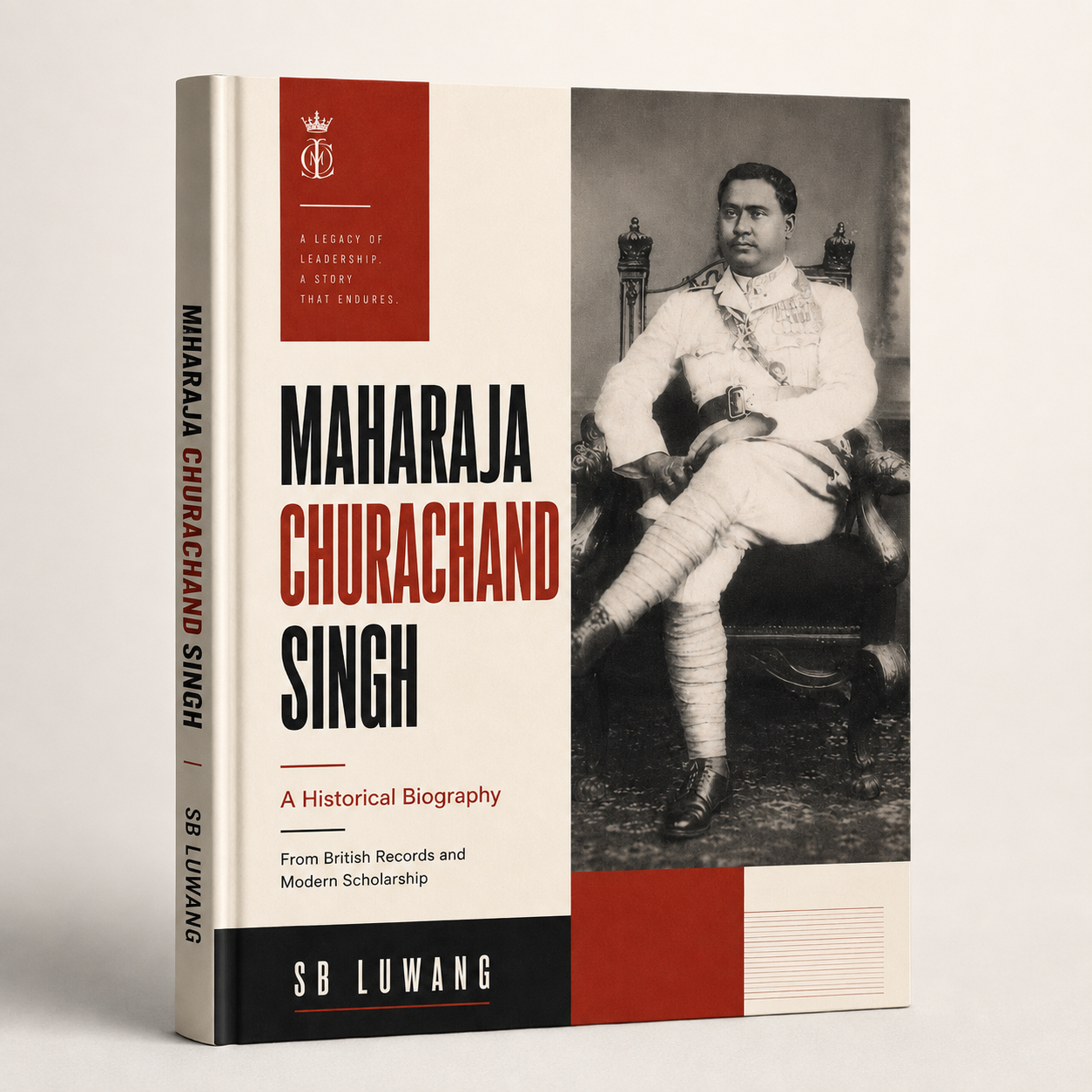
Maharaja Churachand Singh of Manipur is a detailed historical study of one of the most consequential rulers in modern Manipuri history.
Selected as a child ruler after the British victory in the Anglo-Manipur War of 1891, Churachand Singh grew up within a political order fundamentally reshaped by British paramountcy. Educated at Mayo College, Ajmer, and later incorporated into the ceremonial world of the British Indian princely states, he would rule Manipur for nearly half a century.
This book goes beyond a conventional royal biography. It examines how Manipur changed during his reign—from a defeated kingdom into an increasingly bureaucratic princely state, and eventually into a society demanding constitutional reform and political representation.
Based extensively on Manipur State Administration Reports, India Office and Burma Office Lists, British frontier records, official sanads and gazettes, census material, Shodhganga theses, and modern academic studies, the book explores both the achievements and contradictions of the period.
Major themes include the reconstruction of the monarchy after 1891, the transfer of administration in 1907, the Manipur State Darbar, land and revenue administration, roads and public works, education and the growth of a literate political class, hospitals and public health, the State Printing Press, the First World War and the Manipur Labour Corps, the 1917–1919 Anglo-Kuki War, Jadonang and Gaidinliu, Hijam Irabot and the Nikhil Manipuri Mahasabha, the Second Nupi Lan of 1939, and the constitutional reform debates of 1940–41.
Rather than portraying Churachand Singh either as a flawless moderniser or simply as a British puppet, the book presents him as a monarch of transition—a ruler with genuine agency, but one whose authority operated within the limits imposed by British colonial power.
The result is both a biography and a wider political history of Manipur between 1891 and 1941.


Reviews
There are no reviews yet.