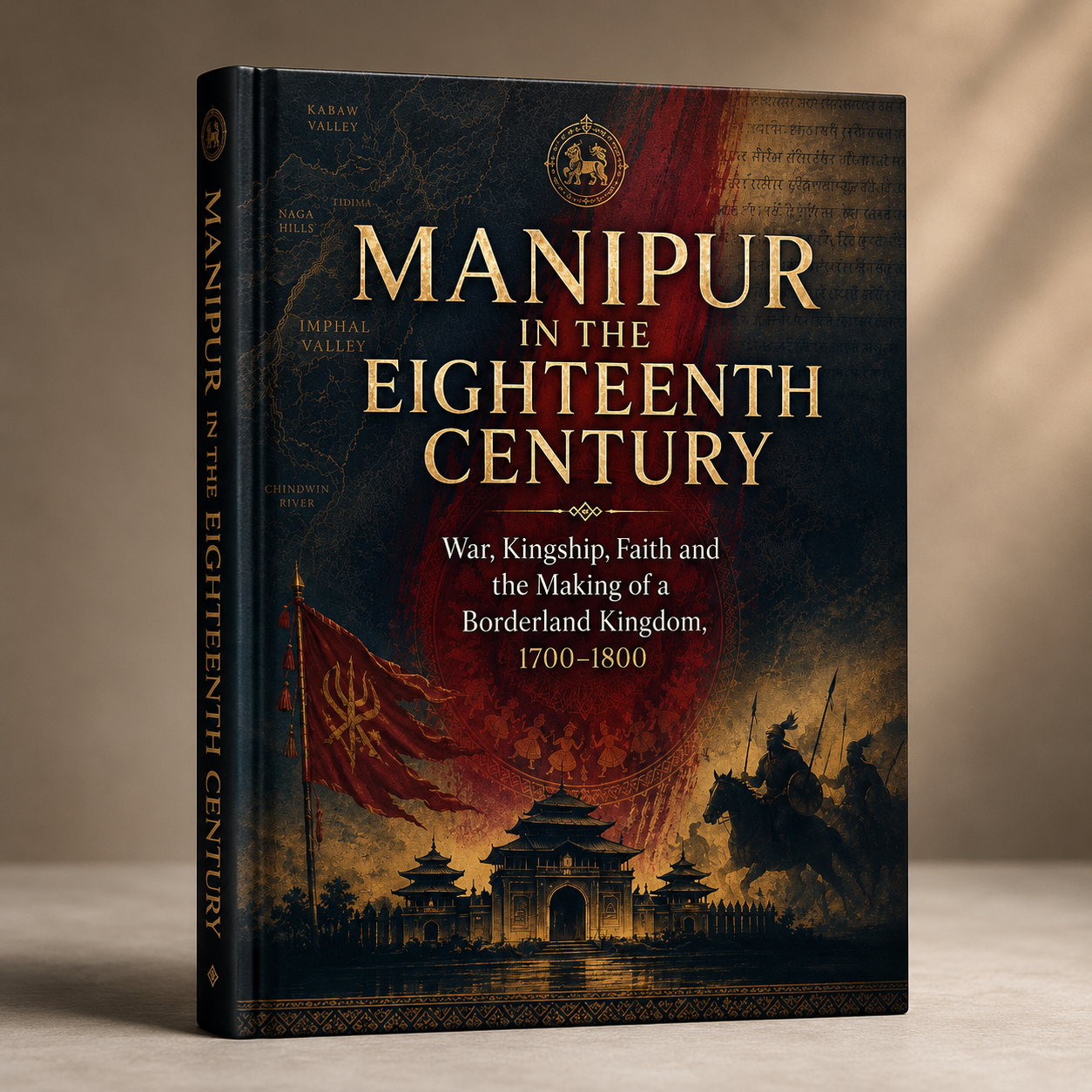
A century of conquest, catastrophe, faith and reconstruction that reshaped Manipur.
The eighteenth century was one of the most consequential periods in the history of Manipur.
Under Garib Niwaz (Pamheiba), the kingdom reached an extraordinary level of military power. Manipuri cavalry crossed the Chindwin, campaigned deep into Upper Burma and threatened the approaches to Sagaing. At home, royal authority expanded while major religious reforms transformed court life, ritual practice and political legitimacy.
Within a generation, the balance of power reversed.
The rise of the Konbaung dynasty turned Burma from a vulnerable neighbour into an expansionist empire. Manipur endured devastating invasions, population displacement, dynastic conflict and exile. The kingdom that had once projected military power toward the Irrawaddy struggled for survival.
From this crisis emerged Bhagyachandra, one of the most influential rulers in Manipuri history.
His restoration depended not only on warfare but also on diplomacy with Assam, the mobilisation of displaced communities and a new conception of sacred kingship centred on Govindaji. During his reign, Gaudiya Vaishnavism interacted with older Meitei religious traditions, while Ras, Sankirtana and temple-centred devotional culture developed into institutions whose influence continues today.
This book examines much more than kings and battles. It explores the lived world of eighteenth-century Manipur: agriculture and famine, markets and coinage, lallup service, women’s labour, Pangals, hill communities, artisans, soldiers, migrants, religious specialists, captives and the cultural corridor connecting Manipur with Burma, Assam, Cachar, Bengal and the wider eastern frontier.
Special attention is given to controversial historical questions—including Puya Mei Thaba, religious transformation and script change—with a careful distinction between contemporary evidence, corroborated history, probable reconstruction, later tradition and contested memory.
Based on an extensive body of sources, including the Cheitharon Kumpapa, Burmese royal orders, Assamese chronicles, East India Company papers, the 1762 Anglo-Manipuri treaty, archival manuscripts, devotional literature and modern academic research, Manipur in the Eighteenth Century presents the period as the history of a dynamic borderland kingdom positioned between South and Southeast Asia.
Key Topics Covered
- Charairongba and the opening of the eighteenth century
- Garib Niwaz/Pamheiba and the warrior kingdom
- Manipuri cavalry, arambai and warfare
- campaigns across the Chindwin and toward Sagaing
- lallup, administration and royal labour
- agriculture, markets, currency and famine
- Vaishnavism and religious transformation
- Puya Mei Thaba—history, evidence and controversy
- temples, manuscripts and court culture
- Chit Sai, Bharat Sai and Gourashyam
- rise of Alaungpaya and the Konbaung dynasty
- Burmese invasions of Manipur
- Bhagyachandra’s exile and restoration
- Manipur’s alliance with the Ahom kingdom
- the 1762 treaty with the East India Company
- early British descriptions of “Meckley”
- Govindaji and devotional kingship
- Ras Lila and Sankirtana
- Meitei, Pangal and hill communities
- women, artisans and ordinary soldiers
- captivity and Manipuri communities in Burma
- trade and migration across the Burma–Manipur frontier
- the political and cultural transformation of Manipur by 1800
Ideal for: readers of Manipuri and Northeast Indian history, scholars and students, competitive-examination learners, libraries, researchers, history enthusiasts and anyone interested in the historical connections between India and Southeast Asia.




Reviews
There are no reviews yet.