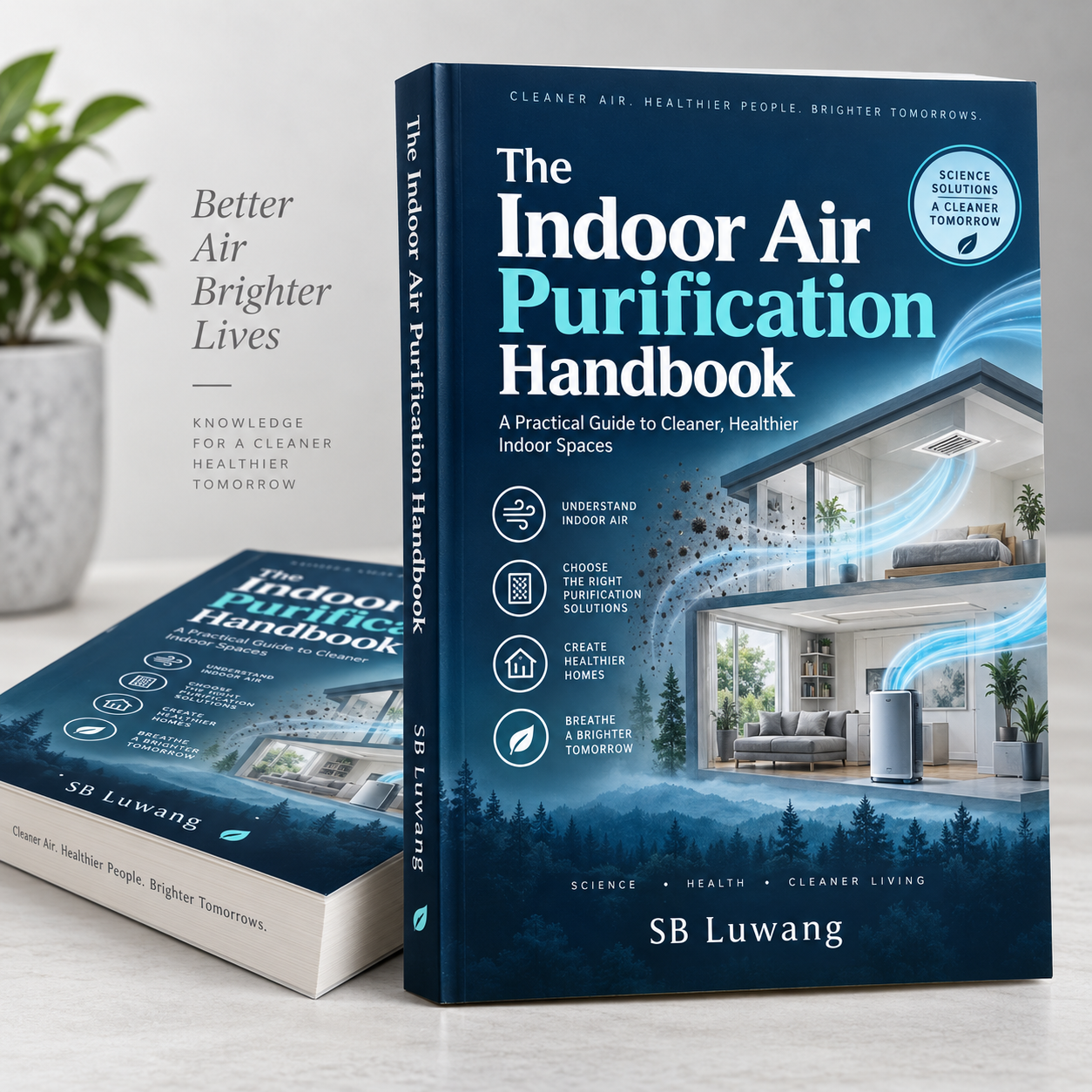
Breathe Smarter. Understand Your Air. Build a Healthier Indoor Environment.
We spend much of our lives indoors—but the air inside homes, offices, classrooms, clinics, and other buildings can contain invisible pollutants including fine particles, smoke, allergens, volatile organic compounds, mold spores, combustion pollutants, and airborne biological particles.
The Indoor Air Purification Handbook by SB Luwang is a comprehensive, practical guide to understanding indoor air pollution and choosing effective methods to control it.
Rather than focusing only on buying an air purifier, this book explains the complete clean-air strategy:
Source Control + Ventilation + Filtration + Air Cleaning
Readers learn how different pollutants behave, how purification technologies actually work, and how to calculate the amount of clean air needed for a particular room.
What You Will Learn
Understand Indoor Air Pollution
Learn about:
- PM1, PM2.5 and PM10
- household dust
- pollen and allergens
- pet dander
- smoke particles
- mold spores
- cooking emissions
- volatile organic compounds
- formaldehyde
- ozone
- carbon monoxide
- nitrogen dioxide
- radon
- airborne microorganisms
Understand HEPA Filtration
Discover:
- what HEPA really means
- how fibrous filters capture particles
- the truth about the 0.3-micron rating
- filter leakage and sealing
- filter efficiency versus whole-device performance
Understand MERV Ratings
Learn how HVAC filters are rated and why choosing the highest-rated filter is not always the right solution.
The book explains:
- MERV ratings
- pressure drop
- HVAC airflow
- filter resistance
- bypass leakage
- system compatibility
Calculate the Correct Air Purifier Size
Learn how to use:
- CADR
- room volume
- ACH
- equivalent clean airflow
with practical formulas and worked examples.
Instead of relying on vague marketing claims, readers learn how to calculate purifier capacity scientifically.
Understand Activated Carbon
Learn why HEPA filters cannot effectively remove many gases and odors and how activated carbon and other sorbents can help control:
- VOCs
- odors
- chemical vapors
- gaseous pollutants
The book also explains adsorption capacity, contact time, carbon quantity and filter breakthrough.
Understand UV Germicidal Air Cleaning
Explore:
- UV-C
- upper-room UVGI
- in-duct UV
- enclosed UV air cleaners
- microorganism inactivation
- UV exposure and safety
Understand Emerging Technologies
Learn about:
- ionizers
- electrostatic precipitation
- bipolar ionization
- plasma technologies
- photocatalytic oxidation
- hydroxyl-generating systems
- reactive oxygen technologies
The book explains both their potential and their limitations.
Understand Ozone Risks
Learn why intentionally generating ozone in occupied spaces can create health risks and why “active purification” should not automatically be assumed to be safer or more effective than mechanical filtration.
Room-by-Room Clean-Air Strategies
The book provides practical guidance for:
- bedrooms
- children’s rooms
- nurseries
- kitchens
- living rooms
- open-plan homes
- offices
- meeting rooms
- classrooms
- schools
- clinics
- healthcare environments
Each space has different pollution sources, occupancy patterns, airflow and filtration requirements.
Special Indoor-Air Problems
Dedicated chapters cover:
Wildfire and Heavy Smoke
Learn how to create a cleaner indoor environment during severe outdoor smoke events.
Urban PM2.5
Understand how outdoor pollution enters buildings and how filtration and ventilation decisions change during high-pollution periods.
Allergies and Pets
Learn strategies for reducing airborne pollen, pet dander and other allergens.
Mold and Dampness
Understand why air filtration alone cannot solve moisture-related problems and why source control remains essential.
Respiratory Aerosols
Learn how ventilation, filtration and engineered air cleaning can reduce airborne particle concentrations.
VOCs and New Furniture
Understand emissions from paints, adhesives, furniture, furnishings and household products.
Smoke, Incense and Indoor Combustion
Learn how combustion can rapidly increase indoor particulate pollution.
Air Purifier Buying Guide
The book teaches readers how to evaluate specifications including:
- CADR
- recommended room size
- filter type
- HEPA claims
- activated carbon
- replacement filter cost
- noise level
- fan speed
- power consumption
- warranty
- certification
- ozone emissions
Readers learn how to separate meaningful engineering specifications from advertising terminology.
DIY Air Filtration
The book also explores lower-cost filtration options, including:
- fan-filter air cleaners
- Corsi–Rosenthal boxes
- HVAC upgrades
- low-cost source-control measures
- ventilation strategies
Practical safety considerations and performance limitations are explained.
Useful Calculations and Worksheets
The handbook includes:
- CADR calculations
- ACH calculations
- room-volume worksheets
- purifier sizing examples
- electricity cost calculations
- filter replacement planning
- indoor-air audit worksheets
Extensive Reference Material
Includes useful appendices covering:
- room-size and CADR tables
- ACH reference calculations
- MERV ratings
- pollutant-source-control matrix
- purifier shopping checklist
- maintenance checklist
- indoor-air-quality audit
- glossary
- references and further reading
Who Should Read This Book?
This handbook is suitable for:
- homeowners
- apartment residents
- parents
- allergy sufferers
- people living in polluted cities
- air-purifier buyers
- office managers
- school administrators
- teachers
- facility managers
- architects
- HVAC students
- technicians
- healthcare administrators
- environmental science students
A Practical Handbook, Not a Product Catalogue
This book does not simply recommend brands or models.
Instead, it teaches readers how indoor-air purification actually works so they can evaluate technologies, calculate requirements, avoid misleading claims, and create an effective clean-air strategy for their own environment.
Cleaner air begins with understanding what is in the air—and choosing the right control method for the right pollutant.


Reviews
There are no reviews yet.