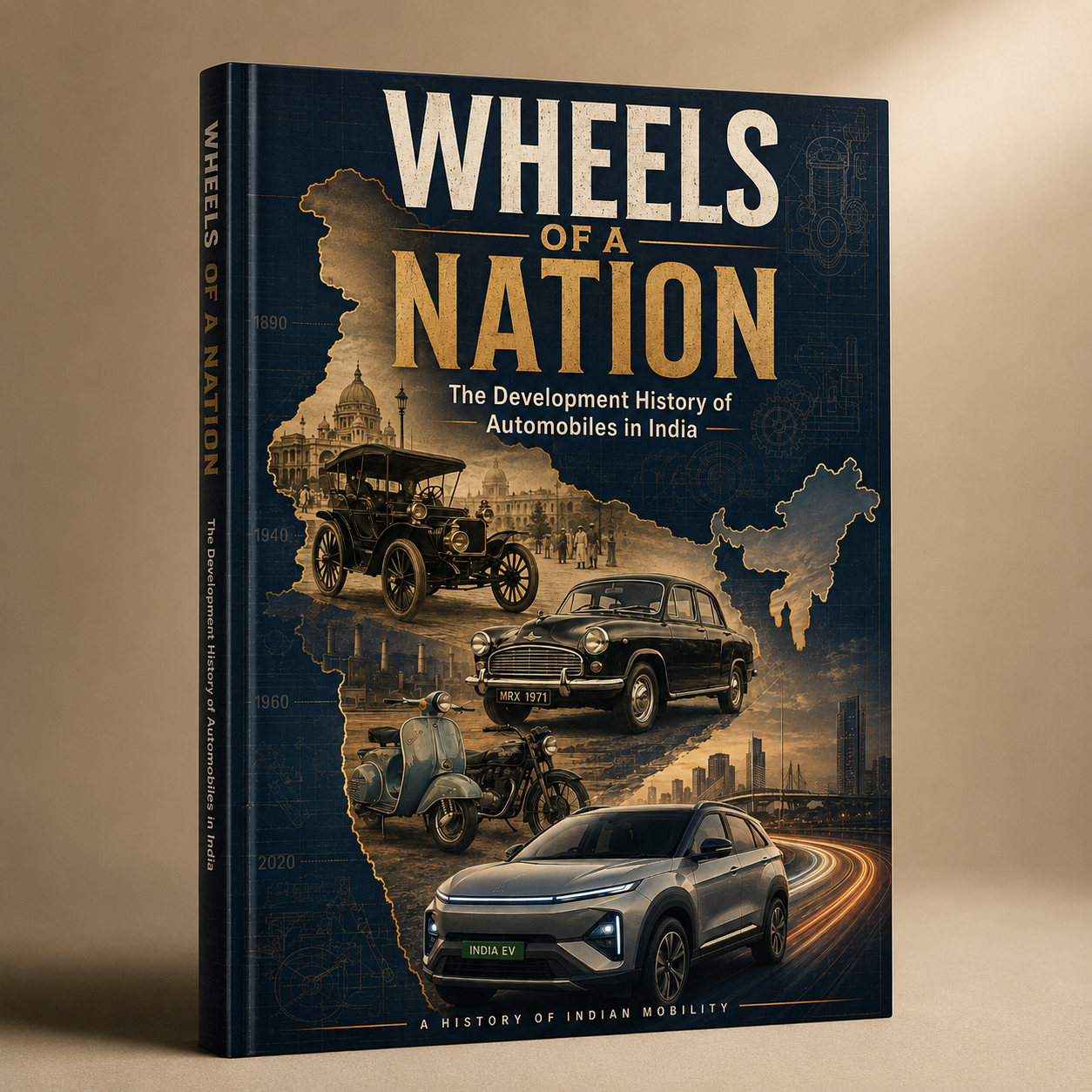
How did India evolve from importing a handful of motor cars to becoming one of the world’s major automobile manufacturing powers?
Wheels of a Nation: The Development History of Automobiles in India traces this extraordinary transformation from the closing years of the nineteenth century to the electric-mobility revolution of the 2020s.
Rather than presenting automobile history simply as a catalogue of famous cars, this book examines the complete ecosystem that made Indian motorisation possible—manufacturers, engineers, component suppliers, government policies, roads, fuel, dealerships, mechanics, consumers and changing technologies.
The journey begins with the earliest imported automobiles of colonial India and follows the establishment of domestic manufacturers such as Hindustan Motors, Premier Automobiles, Tata, Mahindra and Ashok Leyland. It explores the protected industrial economy, the Ambassador and Fiat era, the rise of Bajaj scooters, Royal Enfield motorcycles and India’s vast component industry.
A major section examines the transformation brought by the Maruti 800 in 1983, Japanese production systems and the motorcycle revolution led by companies including Hero Honda, TVS and Bajaj.
The story then moves through the economic reforms of the 1990s and the arrival of Hyundai, Honda, Toyota, Ford and other global manufacturers. It follows landmark Indian engineering projects such as the Tata Indica, Mahindra Scorpio and Tata Nano, as well as India’s emergence as an automobile and component export hub.
The final chapters explore India’s newest automotive transformation:
- Electric vehicles and charging infrastructure
- FAME and PM E-DRIVE
- Tata EVs, Ather, Ola Electric and other new manufacturers
- Battery-cell manufacturing and the ACC PLI programme
- BS-VI emission technology
- Software-defined vehicles and connected cars
- ADAS and automotive cybersecurity
- India’s growing SUV market
- Hydrogen, hybrids and biofuels
- Road safety, congestion and environmental costs
- The future of Indian mobility
The book also includes extensive reference appendices covering major automobile manufacturers, landmark Indian vehicles, government automobile policies, Bharat Stage regulations, historical statistics and automotive terminology.
Ideal For
Automobile enthusiasts, students of Indian economic and industrial history, engineers, business and management students, policy researchers, transport professionals and readers interested in how technology has shaped modern India.
Key Features
- Covers automobile development from the late 1800s to 2026
- 40 detailed chapters across seven historical periods
- Cars, trucks, buses, motorcycles, scooters and three-wheelers
- Ambassador, Premier Padmini, Chetak, Bullet, Maruti 800, Santro, Indica, Scorpio, Nano, Pulsar, Activa and EVs
- Industrial policy from the 1953 Tariff Commission to PLI and PM E-DRIVE
- Maruti and the transformation of Indian manufacturing
- Liberalisation and the arrival of global automakers
- Tata Motors, Mahindra, Bajaj, TVS, Hero and other major Indian companies
- Electric mobility, batteries and software-defined automobiles
- Chronologies, statistical tables and technical glossary
- Balanced discussion of both the achievements and costs of mass motorisation



Reviews
There are no reviews yet.