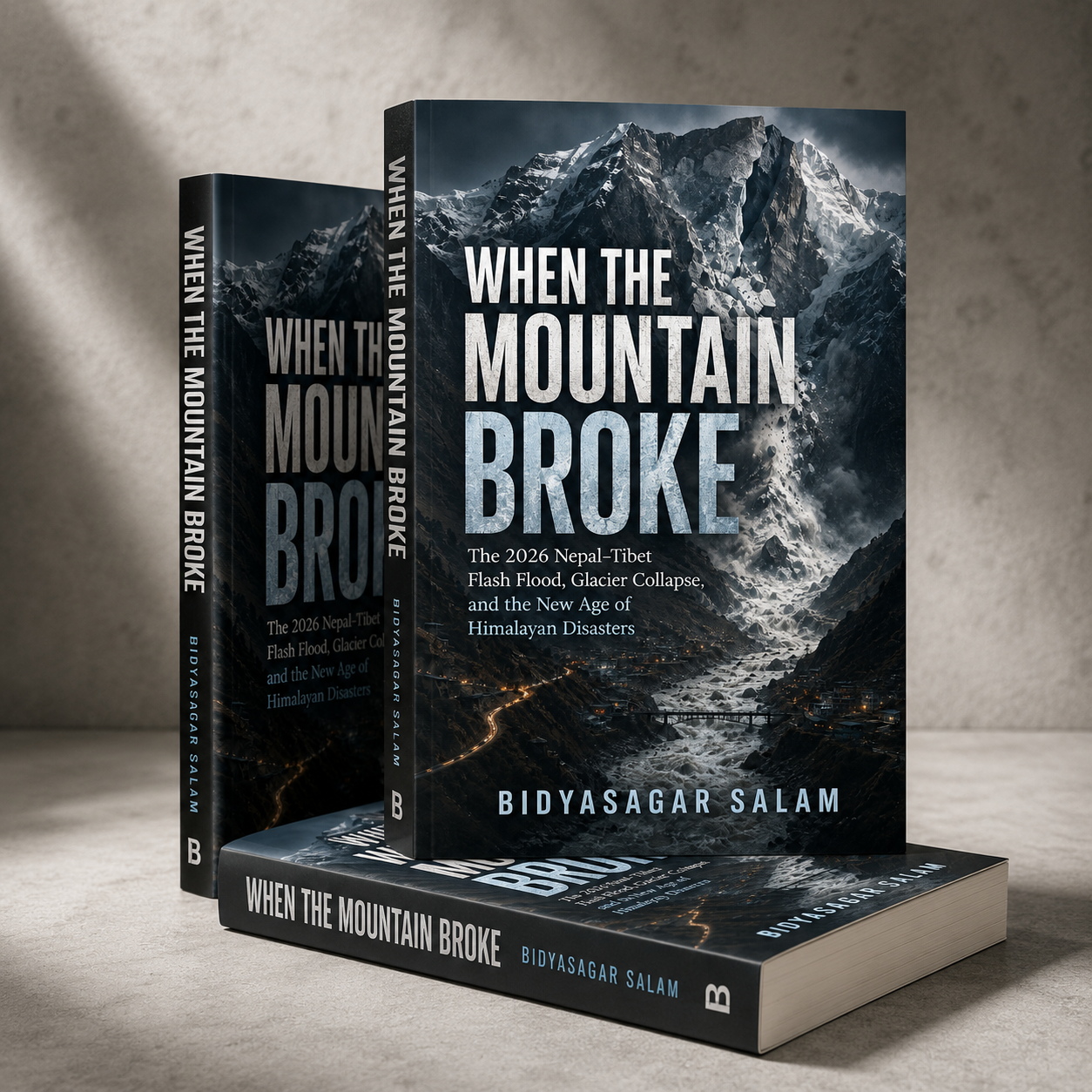
When the Mountain Broke
The 2026 Nepal–Tibet Flash Flood, Glacier Collapse, and the New Age of Himalayan Disasters
On 26 August 2026, a high Himalayan mountain slope involving glacier ice collapsed near the Nepal–Tibet border.
The moving mass generated seismic energy comparable to a moderate earthquake before transforming into a devastating mixture of ice, rock, sediment, mud, and water that travelled through connected mountain rivers for nearly 100 kilometres.
Villages were destroyed. Bridges disappeared. Roads were severed. Hydropower projects were damaged. Pilgrims, tourists, workers, drivers, and border personnel became part of an international search-and-rescue crisis.
At first, the catastrophe was described as another glacial lake outburst flood.
The emerging scientific evidence revealed something far more complex.
When the Mountain Broke reconstructs the disaster from its high-altitude source to the communities downstream and explores what it reveals about the rapidly changing Himalaya.
Inside the Book
Readers will discover:
- How the mountain collapse generated an earthquake-like seismic signal
- Why the disaster was probably not a conventional GLOF
- How rock and glacier ice transformed into a long-runout debris flood
- Why the same Nepal–Tibet corridor had already suffered a major glacial flood in July 2025
- How narrow Himalayan valleys amplify flood and debris-flow destruction
- Why hydropower projects are particularly exposed to cascading mountain hazards
- The experiences of pilgrims, tourists, workers, border communities, and rescuers
- The growing importance of glacier retreat and changing mountain permafrost
- Lessons from Langtang 2015
- The Chamoli 2021 rock–ice avalanche
- The South Lhonak 2023 disaster in Sikkim
- The Thame 2024 glacial flood
- The Purepu Glacier flood of 2025
- Switzerland’s Blatten 2025 glacier-collapse disaster
- Why future warning systems must monitor entire mountain systems—not only glacial lakes
- How Nepal and China could strengthen transboundary early-warning systems
- Practical principles for safer hydropower, roads, tourism, border infrastructure, and Himalayan communities
Two Disasters. Two Mechanisms. Fourteen Months.
One of the book’s central investigations compares two disasters affecting the same wider corridor.
In July 2025, a supraglacial lake on the Purepu Glacier rapidly drained, producing a genuine glacial lake outburst flood.
In August 2026, a catastrophic glacier- and slope-related collapse produced a very different chain of events.
Different beginnings.
The same vulnerable river corridor.
The comparison shows why Himalayan disaster planning must move beyond individual categories such as landslide, avalanche, earthquake, or GLOF and instead prepare for cascading hazards.
The Himalaya in a Warming World
The book also examines the larger cryosphere crisis.
Across the Hindu Kush Himalaya, glaciers are retreating, glacial lakes are forming and expanding, frozen mountain slopes are changing, and infrastructure is moving deeper into increasingly exposed valleys.
Yet the book carefully distinguishes between established regional climate trends and the still-evolving scientific question of exactly what triggered the 26 August 2026 collapse.
This is not a book built around sensational claims.
It is an evidence-based investigation of what is known, what remains uncertain, and what societies can do differently before the next mountain moves.
A Book About Disaster—and Survival
Beyond geology and climate science, When the Mountain Broke is a story about people.
Children who escaped to higher ground.
Workers trapped inside hydropower tunnels.
Families searching for missing relatives.
Pilgrims travelling toward Mount Kailash.
Truck drivers and customs workers whose livelihoods depended on the border.
Rescuers entering a landscape that remained unstable even after the first flood passed.
And communities facing the difficult question of whether rebuilding in the same place also means rebuilding the same risk.
Recommended For
An essential read for anyone interested in:
Nepal • Tibet • Himalayan disasters • glacier collapse • GLOFs • climate change • natural disasters • hydropower • disaster management • early-warning systems • earth science • environmental studies • geography • Himalayan studies • climate adaptation




Reviews
There are no reviews yet.